Getty Museum
Livre des faits de Jacques de Lalaing
- Date
- about 1530
- Medium
- Tempera colors and gold
- Culture
- Flemish
- Department
- Manuscripts
- Institution
- Getty Museum
- Object ID
- 49753875-ec7d-4c30-af83-44cd9eb443e7
From the Getty Museum record
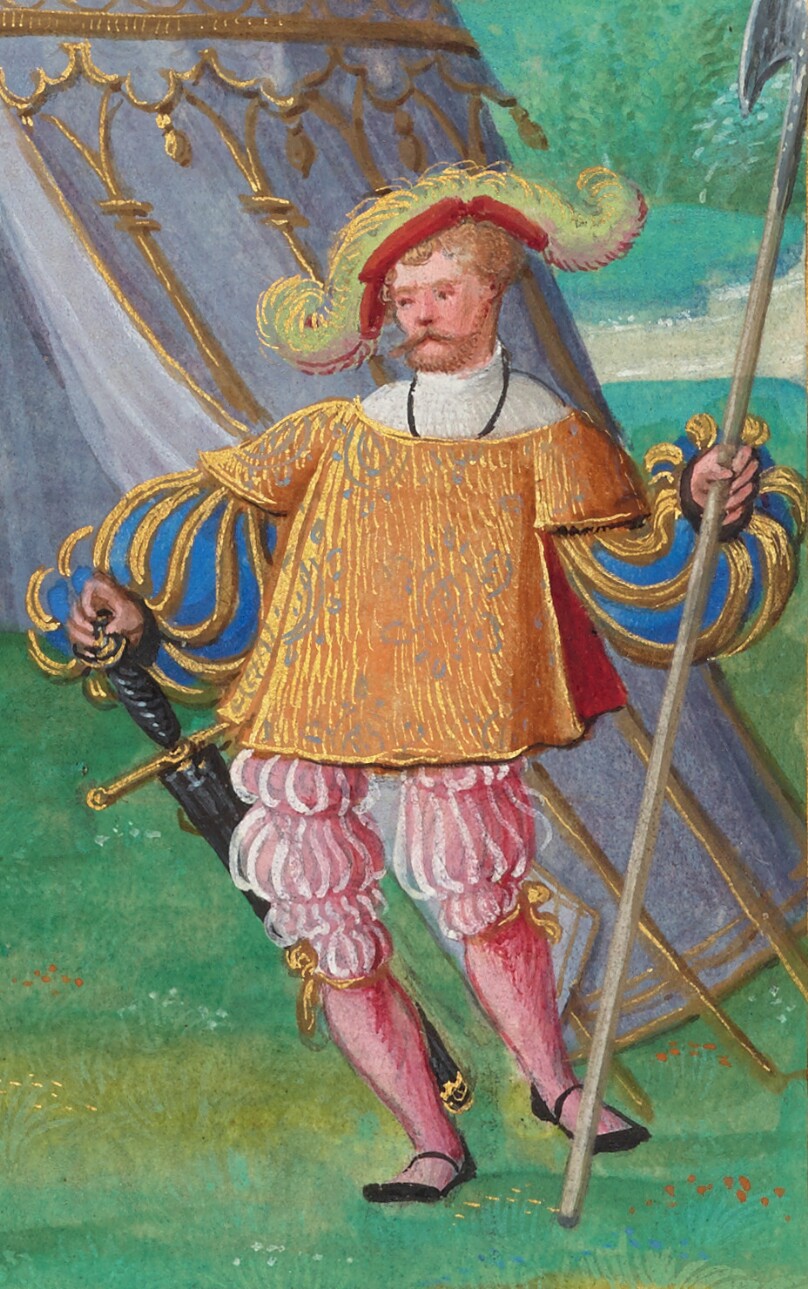
The vibrant text and illuminations of this manuscript concern the adventurous life of Jacques de Lalaing (1421-1453), celebrated knight of the Order of the Golden Fleece and perhaps the most famed tournament fighter of the Middle Ages. The miniatures largely concentrate on Jacques' unparalleled feats of arms, as he made his way across Europe challenging and defeating most of the prominent knights of his day. Jacques was part of the noble Lalaing family of Hainaut in the Walloon region of modern Belgium. Trained in the knightly arts from a young age, Jacques became a knight errant by his early twenties, traveling from country to country spurring the European courts to mount ever more elaborate tournaments as one ruler to the next tried to outdo each other in hosting festivities of increasing splendor and glory. Despite Jacques' almost constant successes in front of adoring crowds, he was anxious to gain yet more victories. He resolved to mount his own pas d'armes (passage of arms), a year-long general challenge to any takers set up at a place known as the Fountain of Tears in the hopes of defeating thirty noble knights before his thirtieth birthday. The image (fol. 113) shows the close level of correspondence between text and image. The pavilion is topped by a sculpture of the Virgin, while the Lady of Tears cries into the fountain (the tears can actually be seen trickling off of her face to become a design element of her dress). The majestic unicorn at left has a collar with three shields. The knights wishing to fight Jacques would tilt at one of the blazons, each symbolizing a different type of weapon to be used in the contest. Jacques stands splendidly dressed at the far right, presiding over the whole. Jacques emerged from the pas d'armes undefeated, and in celebration, went on pilgrimage to Rome. Upon his return in 1441, Duke Philip the Good of Burgundy, his liege lord, rewarded his valor and skill by inducting him into the Order of the Golden Fleece, the most prestigious and exclusive membership at the Burgundian court. By 1453, Jacques was fighting on behalf of Philip the Good as war broke out in the Burgundian dukedom when the city of Ghent revolted over taxes imposed on salt and flour. Jacques distinguished himself as a devoted and courageous warrior. Just weeks before the final battle resulting in the surrender of Ghent, Jacques was killed by artillery at the Castle of Poeke. In the manuscript's final image (fol. 184v), Jacques seems to foresee his own fate as he glances over his shoulder at the cannonball thundering its way towards him from the castle walls. Raging fires in the background, the army's tents seen pitched everywhere, and the rush to load and fire the artillery all convincingly convey the confusion of battle and the chance event that led to the tragic death of the "bon chevalier" (good knight). Jacques' fame had already spread far and wide, but his untimely death soon resulted in his celebration as the most illustrious knight of his age. Later writers also saw him as a symbol of the end of the Age of Chivalry, making much of the irony that the greatest knight of the Middle Ages had been one of the first documented historic figures killed by the modern introduction of gunpowder.
The authoritative record is held by Getty Museum. LinkedCulture surfaces this object and its connections; it does not alter institutional metadata.
Get printable QR codesHide QR codes
Open QR codes for this object page and the museum record. They stay collapsed until needed.
Related across collections
Semantically similar works from Getty Museum and other institutions.