Getty Museum
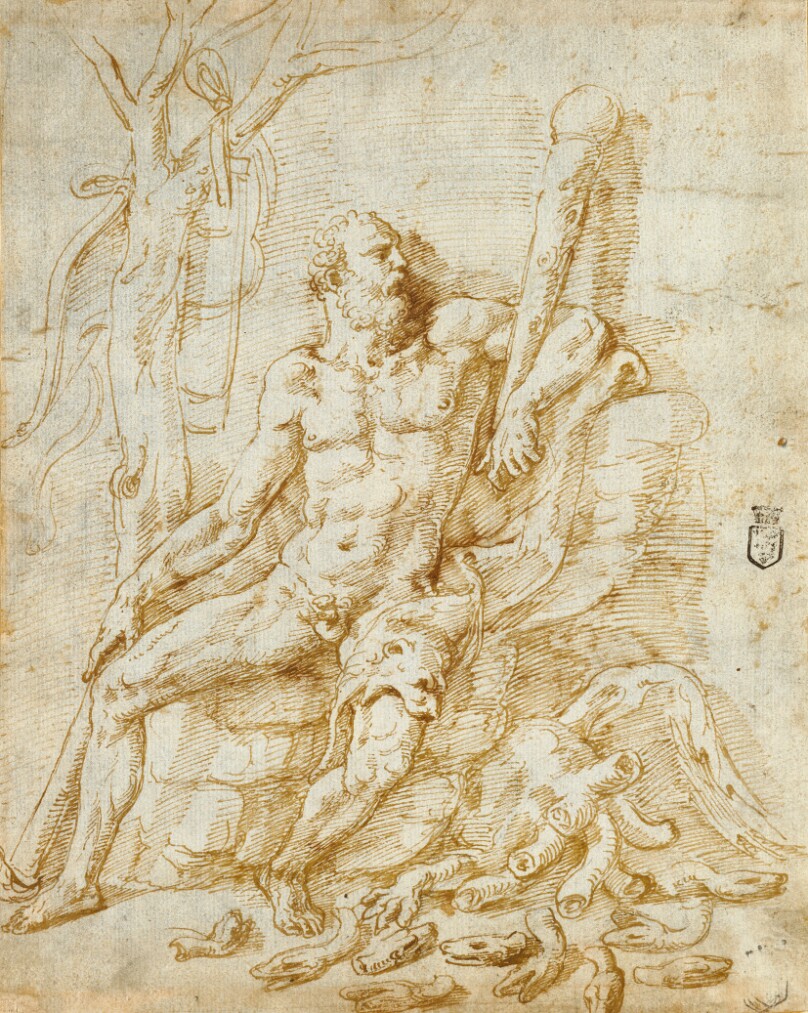
Hercules Resting after Killing the Hydra
Creator
Giulio Romano (Giulio Pippi)Italian Artist · 1499–1546
All works by this person →Giulio Romano was so famous in the century after his death that he is the only "modern" artist mentioned by Shakespeare in a play. A Roman native, by about 1515 he was working for Raphael in the Vatican, eventually becoming the master's most trusted aide. Raphael's late works indicate the increasing torsion and tension that Mannerist artists like Giulio would bring to full flower, ideas that Giuli
More on Getty ULAN- Date
- about 1535
- Medium
- Pen and brown ink (recto); Black chalk, incised for transfer (verso)
- Culture
- Italian
- Department
- Drawings
- Institution
- Getty Museum
- Object ID
- 49f510c1-cf5f-4ef2-a479-bb439c83bda1
From the Getty Museum record
The muscular Greek god Hercules leans back to rest after completing the second of his twelve labors. King Eurystheus had ordered him to kill the monstrous, seven-headed hydra, a water-snake that ravaged the countryside. As soon as the hero cut off one head, however, two more appeared in its place. With the help of a companion, Hercules finally killed the creature by cauterizing the necks with a burning torch. Giulio Romano showed Hercules resting triumphant, with the hydra heads strewn around his feet. He holds his club under one arm and grasps the end of a torch in the other, while his bow and quiver of arrows hang from the tree behind. This drawing does not relate to any known work. Some scholars have suggested that Guilio may have used it as a preparatory study for a print, while others believe he may have made it for a painting project commissioned by his patron, Ercole d'Este. The soldier Ercole was often associated with his namesake Hercules, the personification of strength and courage.
The authoritative record is held by Getty Museum. LinkedCulture surfaces this object and its connections; it does not alter institutional metadata.
Get printable QR codesHide QR codes
Open QR codes for this object page and the museum record. They stay collapsed until needed.
Related across collections
Semantically similar works from Getty Museum and other institutions.