Getty Museum
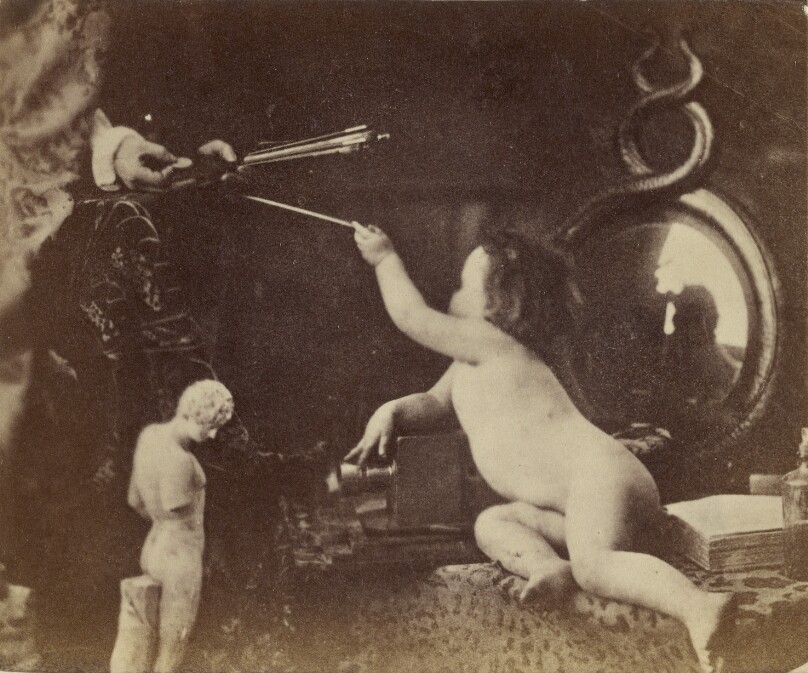
The Infant Photography Giving the Painter an Additional Brush
Creator
Oscar Gustave RejlanderBritish Photographer · 1813–1875
All works by this person →Seeing the fold of a coat sleeve in a photographic portrait prompted Oscar Gustave Rejlander to give up painting for photography. In 1853 Rejlander, eager to learn the wet-collodion process of photography in just one day, paid a hurried visit to a photographer's studio in London. As implied in the name, the wet-plate glass negative had to be used while the collodion was still damp, and the process
More on Getty ULAN- Date
- about 1856
- Medium
- Albumen silver print
- Culture
- British
- Department
- Photographs
- Institution
- Getty Museum
- Object ID
- 4b359f29-8519-4294-85a7-25aa7c4fc51a
From the Getty Museum record
Oscar Rejlander's photograph could be read as a metaphor of his own career. The additional "brush" or image-making tool provided by photography to painters was evident from the beginnings of the medium. Many early practitioners arrived at photography from painting, as did Rejlander. Photographs were often thought of and used as sketching tools for painters. Although photographs never managed to signal the death of painting as initially predicted, they did frequently assume the function that drawing had traditionally held in relation to painting. Compositionally, this is an unusual photograph. Rejlander employs a narrative device from painting: the use of figures, or parts of figures, as allegorical representations for ideas. A very young child represents the infant medium of photography. The Painter appears only as a hand extending into the frame at the upper left, although the traditional arts are also represented by the sculpture reproduction in the lower left corner. The Infant Photography, identified by the camera on which the child supports himself, faces away from the camera, his features totally obscured. The mirror behind the child gives a clear reflection of Rejlander at his camera, making this image.
The authoritative record is held by Getty Museum. LinkedCulture surfaces this object and its connections; it does not alter institutional metadata.
Get printable QR codesHide QR codes
Open QR codes for this object page and the museum record. They stay collapsed until needed.
Related across collections
Semantically similar works from Getty Museum and other institutions.