Getty Museum
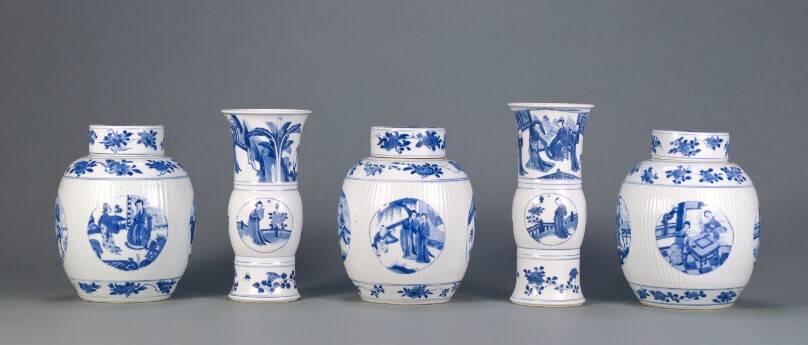
Garniture of Three Lidded Vases and Two Open Vases
Creator
UnknownAll works by this person →More on Getty ULAN- Date
- 1662–1722
- Medium
- Hard-paste porcelain with underglaze blue decoration
- Culture
- Chinese
- Department
- Decorative Arts
- Institution
- Getty Museum
- Object ID
- 4be10638-686a-4c71-b6da-3233f1b380e2
From the Getty Museum record
Chinese factories sent their porcelain pieces made for export down the Yangtze River, first to Nanjing and then to Canton, where Chinese merchants sold them to European traders. Parisian dealers bought most of their imported porcelain from the Dutch East Indies Company in Amsterdam, the main European importer of Far Eastern goods for many years. The volume of this trade in porcelain was enormous: in 1752 a ship headed for Europe sank with 223,303 pieces of porcelain on board. In the 1600s and 1700s, Europeans considered porcelain an exotic and rare material that only the upper classes could afford. Many princes and nobles amassed large collections of Chinese and Japanese ceramics, installing them in rooms known as "China cabinets." There, porcelains in arrangements known as garnitures decorated entire walls, with vases, plates, and cups set on brackets or overmantels, in and on top of cabinets, and along shelves or even the floor. After eagerly purchasing Chinese and Japanese wares for hundreds of years, Germans finally discovered the formula for "true" or hard-paste porcelain in the first decade of the 1700s.
The authoritative record is held by Getty Museum. LinkedCulture surfaces this object and its connections; it does not alter institutional metadata.
Get printable QR codesHide QR codes
Open QR codes for this object page and the museum record. They stay collapsed until needed.
Related across collections
Semantically similar works from Getty Museum and other institutions.