Getty Museum
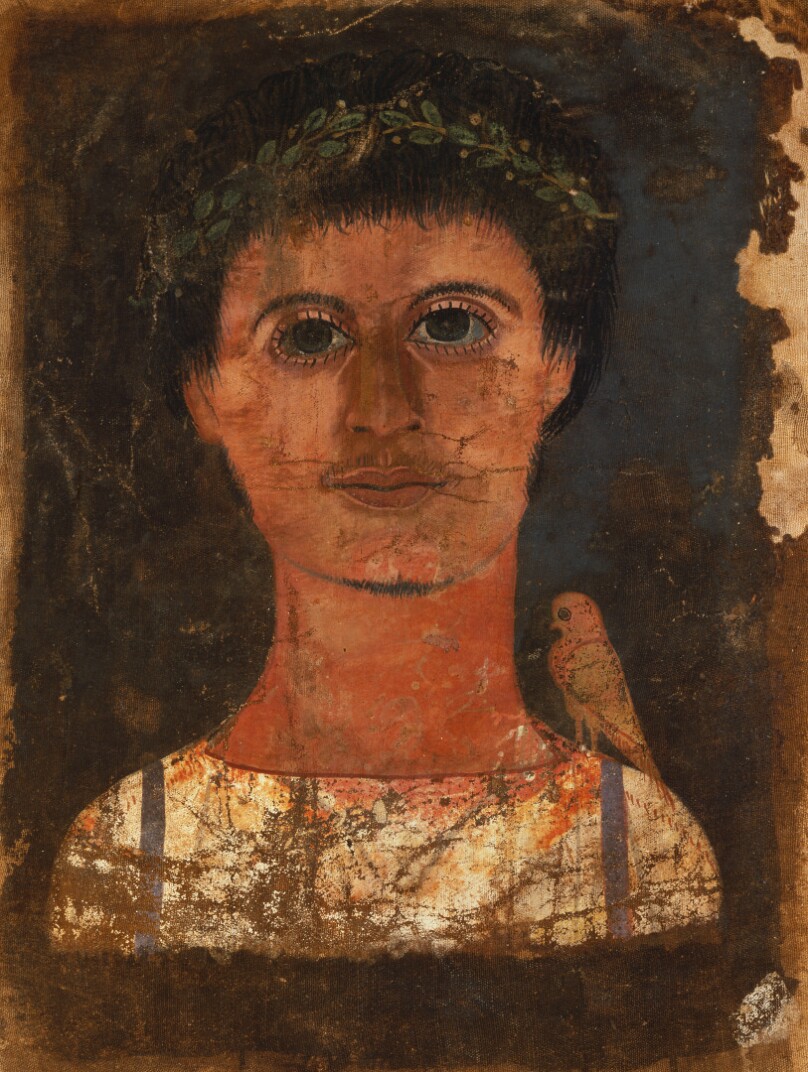
Mummy Shroud with Painted Portrait of a Boy
Creator
UnknownAll works by this person →More on Getty ULAN- Date
- A.D. 150–250
- Medium
- Tempera on linen
- Culture
- Romano-Egyptian
- Department
- Paintings
- Institution
- Getty Museum
- Object ID
- 4c1cec27-7592-486f-964d-04975a955a0d
From the Getty Museum record
Shrouds of finely woven linen provided an alternative means of covering the head and face of the deceased in Roman Egypt, where the portrait followed traditional funerary iconography equivalent to those on wooden panels. Here, a young man on the cusp of adulthood stands out in his white tunic against a carbon black ground. A small falcon in yellow and red ochre stands on his proper left shoulder. Though lacking divine regalia, the bird is surely a simple rendition of the Egyptian god Horus, the son of Isis and Osiris, or Harpocrates, the child of Isis and Serapis, who in bird form so often accompanies the deceased on his journey to the other world. The subject wears a wreath of green leaves with berries painted in yellow. Narrow purple *clavi* (woven stripes denoting Roman citizenship) extend down from his shoulders. The simple oval neckline and absence of a mantle differ markedly from the vast majority of male portraits, where a mantle is always draped over one shoulder (such as the Portrait of a Man, [74.AP.11](http://www.getty.edu/art/collection/objects/7140/unknown-maker-mummy-portrait-of-a-bearded-man-romano-egyptian-about-ad-150-170/)). Here, a series of short red strokes creates a textile pattern extending outward from the neck across each shoulder. The artist has added a few specific physical characteristics to animate the portrait and identify the approximate age and status of the deceased. A thin growth of facial hair is applied in tempera (pigment suspended in animal glue), a fast-drying medium used here to render the young man’s moustache and brittle beard with passages of short black brushstrokes. His eyebrows, eyelashes and locks of hair are carefully delineated in various thicknesses of carbon-black strokes: upper and lower eyelashes outline the eyelids; eyebrows are shaped by quick vertical movements, while longer strokes create the hairline bordering the brow and lap over the ears. Tempera can flatten the surface appearance of a painting, and when added to the linearity of the facial features, a stylistic date of AD 150-250 (probably later in that range) is probable and is supported by Carbon- 14 dates of AD 72-213.
The authoritative record is held by Getty Museum. LinkedCulture surfaces this object and its connections; it does not alter institutional metadata.
Get printable QR codesHide QR codes
Open QR codes for this object page and the museum record. They stay collapsed until needed.
Related across collections
Semantically similar works from Getty Museum and other institutions.