Getty Museum
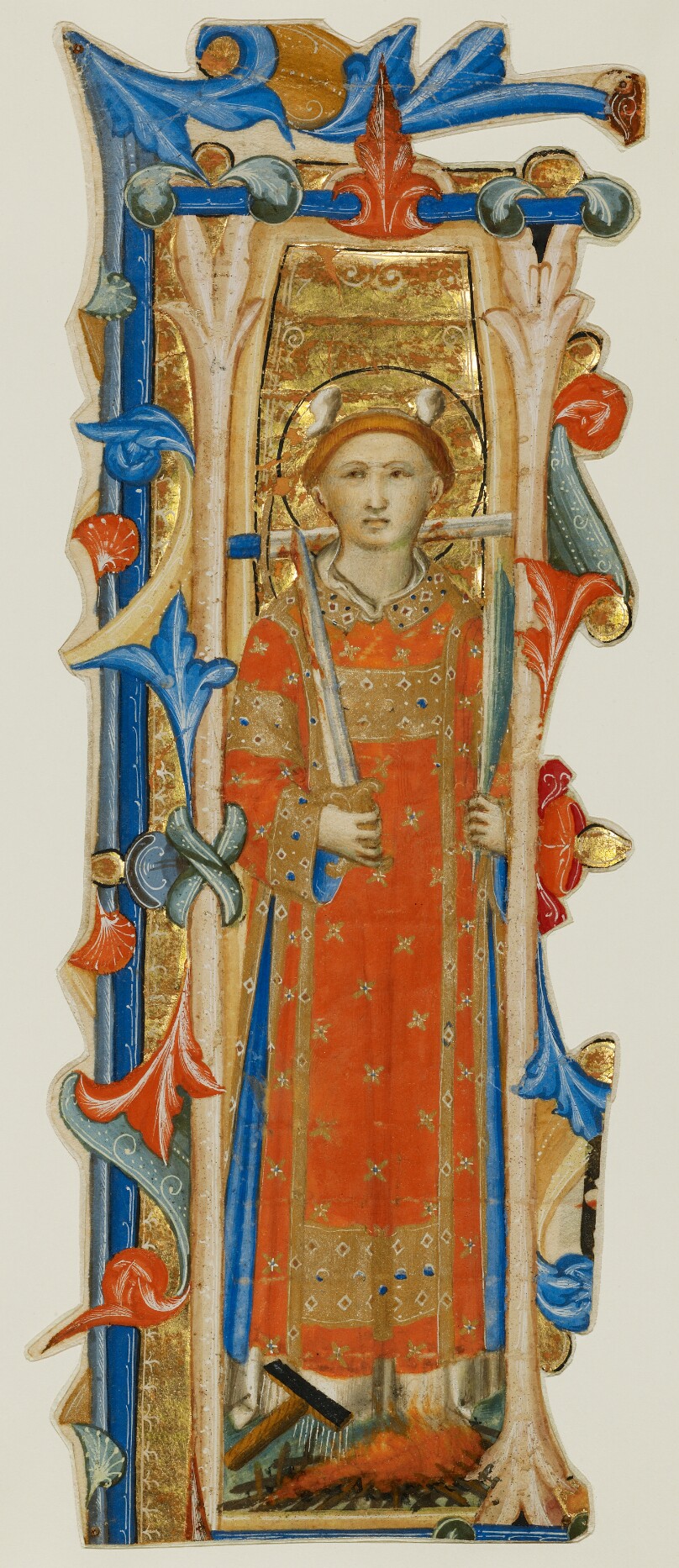
Initial I: A Martyr Saint
Creator
Lippo VanniItalian Illuminator · 1340–1375
All works by this person →Lippo Vanni worked in and around Siena as a manuscript illuminator as well as a fresco and panel painter. The commissions he received after the mid-1300s indicate that patrons thought of him as one of the leading painters of his day. In 1356, a record of the painters working in Siena lists Vanni's name first. Vanni illuminated choir books for the church in San Gimignano and a hospital in Siena. He
More on Getty ULAN- Date
- third quarter of 14th century
- Medium
- Tempera colors, gold leaf, and ink
- Culture
- Italian
- Department
- Manuscripts
- Institution
- Getty Museum
- Object ID
- 4d0ea87f-6edd-4dd7-89d0-19f5225c014c
From the Getty Museum record
The elegant figure of this saint, which fully dominates the space of the initial *I* , is notable for its strong, monumental bearing. The artist employed a warm, glowing palette of gold and orange, endowing the figure with a luminous quality appropriate to a holy person. The initial, cut from an antiphonal, probably introduced a generic text devoted to martyrs, which was individualized by the insertion of a particular saint's name. The saint shown is thus not a specific person but a composite martyr accompanied by the attributes of a number of saints who died for the Christian faith. The wool comb at the figure's feet was an instrument used to torture Saint Blasius, the rocks could refer to the stoning of Saint Stephen, the fire may refer to Saint Lawrence who was roasted alive, and the swords could indicate any number of martyr saints. Finally, the palm frond is a symbol of the martyr's triumph over death in the Christian afterlife.
The authoritative record is held by Getty Museum. LinkedCulture surfaces this object and its connections; it does not alter institutional metadata.
Get printable QR codesHide QR codes
Open QR codes for this object page and the museum record. They stay collapsed until needed.
Related across collections
Semantically similar works from Getty Museum and other institutions.