Getty Museum
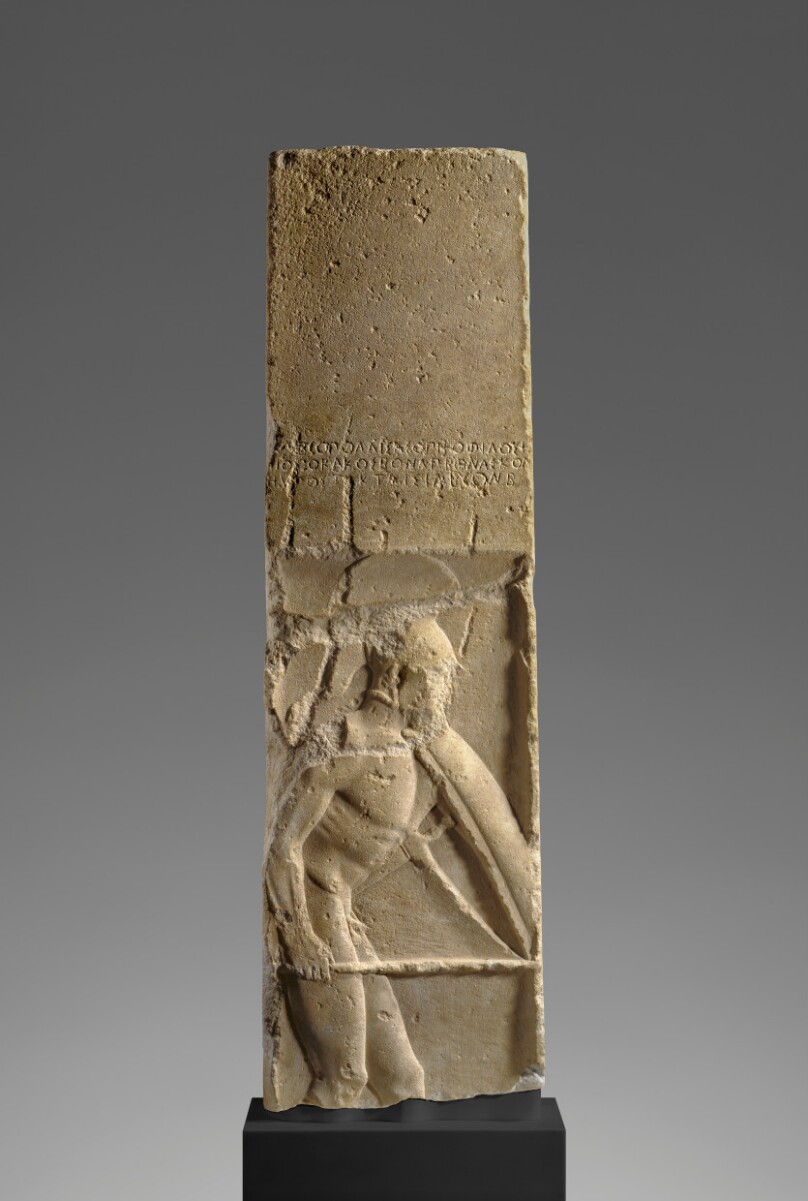
Grave Stele of Pollis
Creator
UnknownAll works by this person →More on Getty ULAN- Date
- about 480 B.C.
- Medium
- Parian marble
- Culture
- Greek (Megarian)
- Department
- Sculpture
- Institution
- Getty Museum
- Object ID
- 4fd61daf-9843-437e-af8b-43617fe72b45
From the Getty Museum record
The muscular warrior carved in low relief on this stele (gravestone) wears only a crested helmet and carries a shield, sword, and spear. He appears to be advancing into battle with his shield raised and his spear ready. The strap that suspended the sword hanging at his side was originally added in paint, as were other details of the decoration. The figure is identified in the Greek inscription written above him as Pollis: ΛΕΓΟ ΠΟΛΛΙΣ ΑΣΟΠΙΧΟ ΦΙΛΟΣ Η[Υ]ΙΟΣ: Ο ΚΑΚΟΣ ΕΟΝ ΑΠΕΘΝΑΣΚΟΝ ΗΥΠΟ ΣΤ[Ι]ΚΤΑΙΣΙΝ ΕΓΟΝΕ (“I, Pollis, dear son of Asopichos, speak: Not being a coward, I, for my part, perished at the hands of the tattooers.”). The tattooers referred to in the epitaph may be the Persians, or the Thracians, a tribe from the north of Greece that fought on the side of the Persian invaders in the war of 480–479 B.C. Although the Greeks were victorious, Pollis lost his life. The form of the Greek letters seen here was distinctive to Megara, a city located between Athens and Corinth. In form, the stele retains the tall narrow shape popular in the Archaic period, yet its decoration looks forward to the early Classical period. Sculptors of the period from about 480-450 B.C. displayed a new interest in the representation of space, movement, and human anatomy. Shown mostly in profile view with accurate musculature and a foreshortened shield, the figure of Pollis conveys a sense of three-dimensionality. This effect is all the more remarkable, given the stele’s very shallow carving.
The authoritative record is held by Getty Museum. LinkedCulture surfaces this object and its connections; it does not alter institutional metadata.
Get printable QR codesHide QR codes
Open QR codes for this object page and the museum record. They stay collapsed until needed.
Related across collections
Semantically similar works from Getty Museum and other institutions.