Getty Museum
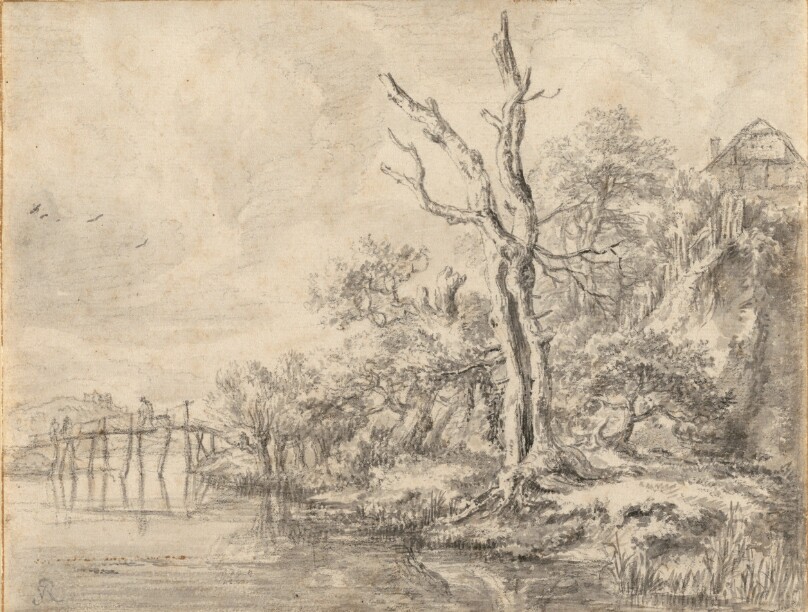
Dead Tree by a Stream at the Foot of a Hill
Creator
Jacob van RuisdaelDutch Artist · 1628–1629
All works by this person →Jacob van Ruisdael learned to paint from his father, a framemaker, art dealer, and painter, and from his uncle, Solomon van Ruysdael. After studying landscape painting in Germany for ten years, he settled in Amsterdam. There he maintained a flourishing painting studio, where he trained the next generation of Dutch landscape painters, including Meindert Hobbema. Ruisdael's dramatic, naturalistic re
More on Getty ULAN- Date
- about 1650–1660
- Medium
- Black chalk, point of brush and light and dark gray washes
- Culture
- Dutch
- Department
- Drawings
- Institution
- Getty Museum
- Object ID
- 500df660-0130-41ab-ae60-1a8b66148fdb
From the Getty Museum record
For Jacob van Ruisdael, decayed trees with bare, twisted branches could speak as eloquently as thriving ones. The aged tree was a long-standing theme in Dutch and Flemish landscape imagery, but in Ruisdael's hands it became a very personal expression. Ruisdael focused this composition around a hollow tree whose bare limbs reach upward: a heroic element in the landscape. Its lifeless skeleton symbolizes the transience of human life, a favorite Ruisdael theme, and reminds viewers of the suffering and endurance required in life. Yet Ruisdael also set the dead tree amidst healthy ones, showing that both life and death have a share in nature. To balance the scene compositionally, Ruisdael contrasted the dramatic tree with a placid stream and picturesque footbridge on the left. Ruisdael began by sketching the composition in black chalk. He then brushed in a range of tones of gray wash, creating a rich diversity of textural and light effects, especially on the right. Subjects reflecting life's uncertainty and brevity were popular in post-Reformation Holland, where religious painting had nearly disappeared. The *vanitas* themes adopted by Dutch still life painters came from the same urge to record the fleeting character of nature.
The authoritative record is held by Getty Museum. LinkedCulture surfaces this object and its connections; it does not alter institutional metadata.
Get printable QR codesHide QR codes
Open QR codes for this object page and the museum record. They stay collapsed until needed.
Related across collections
Semantically similar works from Getty Museum and other institutions.