Getty Museum
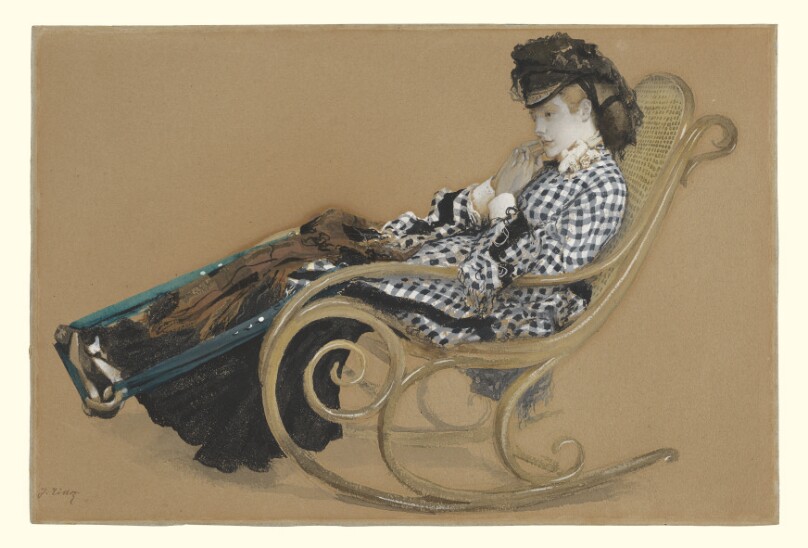
Young Woman in a Rocking Chair, study for the painting "The Last Evening"
Creator
Jacques Joseph TissotFrench Artist · 1836–1902
All works by this person →Jacques Joseph Tissot was born in Nantes, a port city located where the Loire River flows into the Atlantic Ocean. When Tissot turned twenty in 1856, he moved to Paris to study with Louis Lamothe and Hippolyte Flandrin; three years later he made his well-received Salon debut. Though he lived in Paris, Tissot's caricature drawings frequently appeared in the popular English magazine *Vanity Fair*. A
More on Getty ULAN- Date
- about 1873
- Medium
- Brush with gouache and watercolor, over graphite, on brown paper
- Culture
- French
- Department
- Drawings
- Institution
- Getty Museum
- Object ID
- 501d448c-4edd-4542-a8a5-533863b5207d
From the Getty Museum record
Jacques Joseph Tissot made this drawing as an elaborate study for a well-known painting, *The Last Evening,* now in the collection of the Guildhall Art Gallery in London. The young woman is contemplating the departure of her love, a sailor who is preparing to go out to sea. Tissot, who often drew and painted people in introspective states of mind, captured her sitting pensively in a rocking chair. She seems lost in thought, staring forward. The fingertips of her right hand barely rest against her pale cheek while her legs extend to reach the chair's footrest. He portrays the woman's clothes realistically, carefully depicting her black-and-white plaid tunic, and juxtaposing it with the brown-red tartan of her skirt. A hat wrapped in gauzy fabric surrounds her shock of strawberry-blonde hair. Tissot used heightening to create vivid and shiny highlights along the chair's frame, while gentle shadows fall beneath the chair, adding depth. His use of gouache simulates the look of oil painting. Tissot's friend, Margaret Freebody, served as the model for the study and painting. Freebody's husband and brother appear in the painting as well, which depicts the figures gathered on the deck of a ship.
The authoritative record is held by Getty Museum. LinkedCulture surfaces this object and its connections; it does not alter institutional metadata.
Get printable QR codesHide QR codes
Open QR codes for this object page and the museum record. They stay collapsed until needed.
Related across collections
Semantically similar works from Getty Museum and other institutions.