Getty Museum
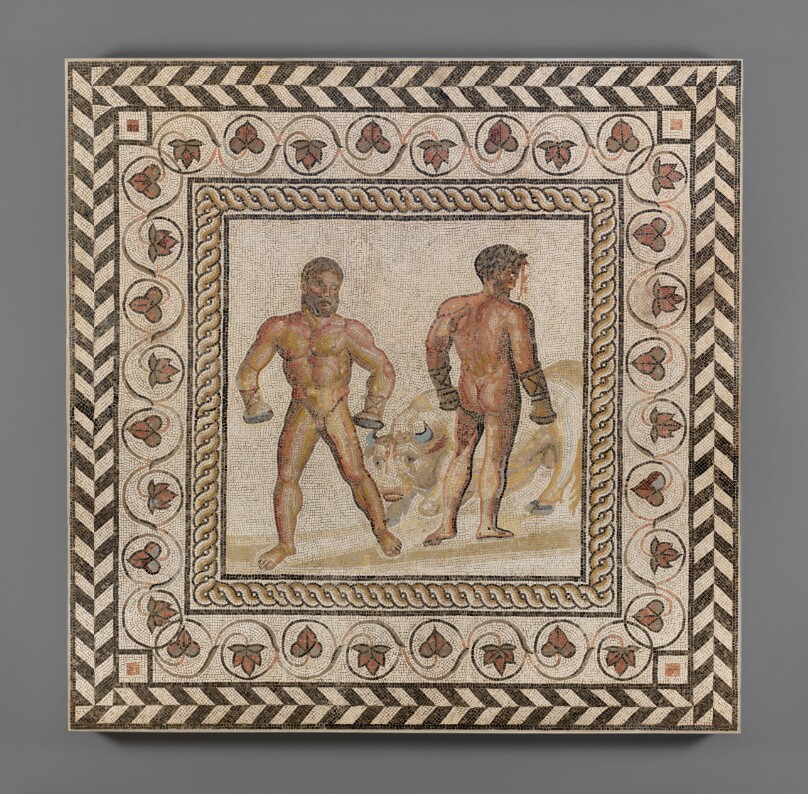
Mosaic Floor with Combat Between Dares and Entellus
Creator
UnknownAll works by this person →More on Getty ULAN- Date
- A.D. 175–200
- Medium
- Stone and glass tesserae
- Culture
- Gallo-Roman
- Department
- Architecture
- Institution
- Getty Museum
- Object ID
- 50a75876-0cf8-458a-bb51-5987e65c0b88
From the Getty Museum record
In this square mosaic panel two boxers stand back-to-back in front of a kneeling white bull, whose forehead is dripping with blood; the figure to the right seems to be bleeding from his head as well. Both men wear Roman gloves called caesti, strips of leather weighted with lead or iron, wrapped around their hands and forearms, but are otherwise nude. The figures are rendered in polychromy on a white background, and are composed of tesserae of natural stones, principally red, black, and grey; the horns of the bull, however, are of pale blue, glass paste tesserae.A dramatic passage from Virgil’s Aeneid (Book 5, lines 362–484) inspired this scene—the conclusion of a boxing match in Sicily between Dares, a young Trojan (right), and Entellus, an older Sicilian (left). In the epic poem of Rome's founding, Aeneas honored the anniversary of his father's death by holding elaborate funeral games, including a boxing match. This match pitted the Trojan Dares against the local Sicilian champion Entellus. Although the fight was uneven because Dares was much younger and fitter than his opponent, eventually Entellus became enraged and pummeled the younger man. The fight was called and the victor Entellus was awarded his prize—a white bull, which he then sacrificed by shattering its skull with a single blow from his fist to demonstrate his strength and to honor the gods. A central panel removed from a much larger floor, this mosaic was one of several that decorated an ancient countryside villa near the modern town of Villelaure in southern France, once part of the Roman province of Gaul. The illustration of this passage from the Aeneid is rare in Roman art. In fact, the only other mosaics known that depict this passage are from the same area, and also date to the mid- to late-second century A.D., suggesting that all are a product of the same local workshop.
The authoritative record is held by Getty Museum. LinkedCulture surfaces this object and its connections; it does not alter institutional metadata.
Get printable QR codesHide QR codes
Open QR codes for this object page and the museum record. They stay collapsed until needed.
Related across collections
Semantically similar works from Getty Museum and other institutions.