Getty Museum
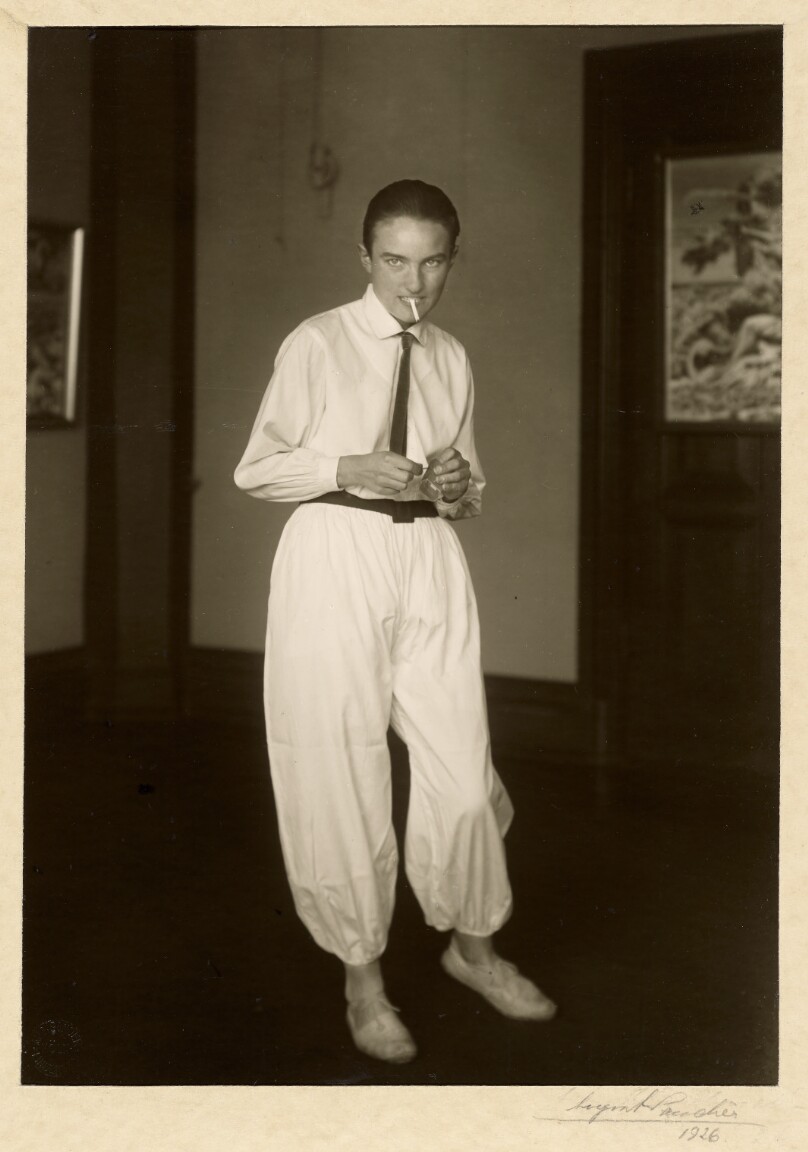
Painter's Wife (Helene Abelen)
Creator
August SanderGerman Photographer · 1876–1964
All works by this person →During military service, August Sander was an assistant in a photographic studio in Trier; he then spent the following two years working in various studios elsewhere. By 1904 he had opened his own studio in Linz, Austria, where he met with success. He moved to a suburb of Cologne in 1909 and soon began to photograph the rural farmers nearby. Around three years later Sander abandoned his urban stud
More on Getty ULAN- Date
- 1926
- Medium
- Gelatin silver print
- Culture
- German
- Department
- Photographs
- Institution
- Getty Museum
- Object ID
- 53131f0c-8aca-4197-82b0-a8f6726f72c3
From the Getty Museum record
> During the 1920s August Sander (1876-1864) befriended many Cologne artists. In 1926 he was asked by the painter Peter Abelen to create a portrait of Abelen's young wife, Helene, who posed in their apartment surrounded by her husband's artworks. The resulting picture is a striking anomaly in Sander's work, an image so stylishly suggestive and clever that a viewer might expect to find it in the pages of a glossy women's magazine. It may be the closest Sander ever came to taking a sophisticated fashion shot. > > The model is seen in masculine garb, wearing a crisp white shirt, a thin necktie, and trendy pants. Sporting a man's hairstyle and clenching a cigarette between her teeth, she signals her defiance of traditional gender roles. In a gesture both daring and tantalizing, she holds a match to the striker, ready to ignite the scene by the sheer force of her determination. She is literally and figuratively playing with fire, testing the limits of her transgressive stance. This is the so-called new woman of Weimar, a glittering media image of the emancipated female that was both fascinating and deeply threatening to the German establishment of the time. > > Many years after this [photograph](https://www.moma.org/collection/works/193837) was taken, the Abelens' daughter remarked that the woman in this picture was really Peter's creation. On or off camera, he liked to shape every aspect of Helene's appearance, designing her clothes and cutting her hair. It seems that her provocative posture was also his idea—a self-conscious enactment of the new woman he desired as his wife. The viewer, therefore, is witnessing a carefully orchestrated performance, a theatrical ploy that is at once seductive and unnerving. It is not known how the photographer figured in all this, whether he was an eager participant in or unwitting accomplice to the private fantasy projected by his clients. (See Sander’s [portrait](https://www.getty.edu/art/collection/objects/34661/august-sander-painter-peter-abelen-maler-peter-abelen-german-about-1924-1928/) of Peter Abelen.) > > Originally published in *August Sander*, In Focus: Photographs from the J. Paul Getty Museum by Claudia Bohn-Spector (Los Angeles: J. Paul Getty Museum, 2000), 48. ©2000, J. Paul Getty Trust.
The authoritative record is held by Getty Museum. LinkedCulture surfaces this object and its connections; it does not alter institutional metadata.
Get printable QR codesHide QR codes
Open QR codes for this object page and the museum record. They stay collapsed until needed.
Related across collections
Semantically similar works from Getty Museum and other institutions.