Getty Museum
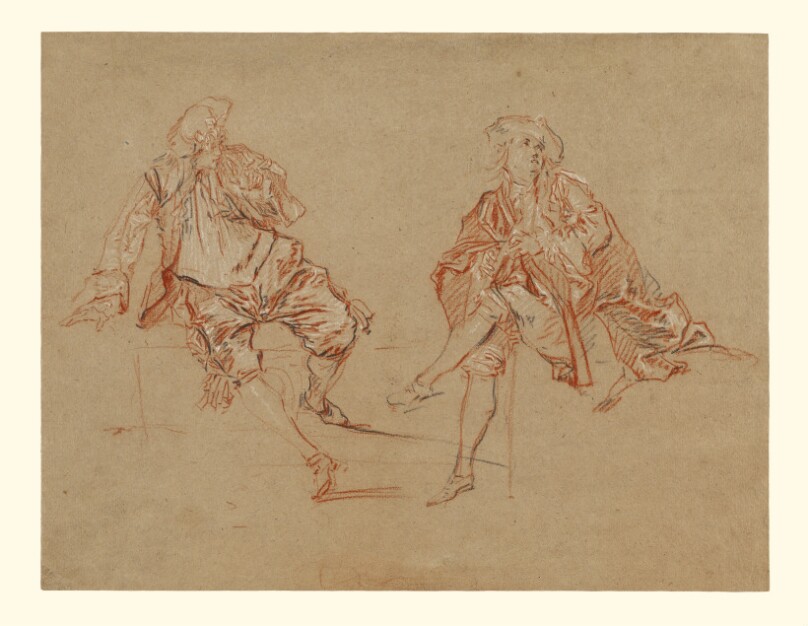
Two Seated Men
Creator
Nicolas LancretFrench Artist · 1690–1743
All works by this person →Nicolas Lancret's early career never indicated his future renown as Paris's best-known practitioner of the *fête galante*. After training as an engraver, he apprenticed to a moderately successful history painter. By 1708 he was studying at the Académie Royale, from which he was expelled for bad behavior. Probably because of the popularity of Jean-Antoine Watteau's elegant new *fêtes galante,*Lancr
More on Getty ULAN- Date
- about 1725–1730
- Medium
- Red, black and white chalk
- Culture
- French
- Department
- Drawings
- Institution
- Getty Museum
- Object ID
- 53b86693-2016-4c2c-8bf6-af467a925fa7
From the Getty Museum record
Using a delicate pattern of red chalk lines to illustrate the play of light on the folds of the two men's clothing, Nicolas Lancret portrayed an elegant courtier on the left and a flutist on the right. Black chalk strokes define the elements of emphasis: the rippling folds on their breeches and cloak and each man's little nose and mouth. White lines add touches of silvery highlights to the costumes. Like his idol and rival Jean-Antoine Watteau, Lancret particularly favored the effects of combining three colors of chalk in the technique known as *trois crayons* . Among the many artists who imitated the brilliant flickering style of Watteau's chalk work, Lancret mastered it best and developed it into a personal idiom, evolving strokes that were looser and more ethereal than those of Watteau. Lancret probably sketched the figures as a life study, not in preparation for a particular painting. Later, when he required a particular gesture or movement for one of his paintings, he would have referred back to his drawings.
The authoritative record is held by Getty Museum. LinkedCulture surfaces this object and its connections; it does not alter institutional metadata.
Get printable QR codesHide QR codes
Open QR codes for this object page and the museum record. They stay collapsed until needed.
Related across collections
Semantically similar works from Getty Museum and other institutions.