Getty Museum
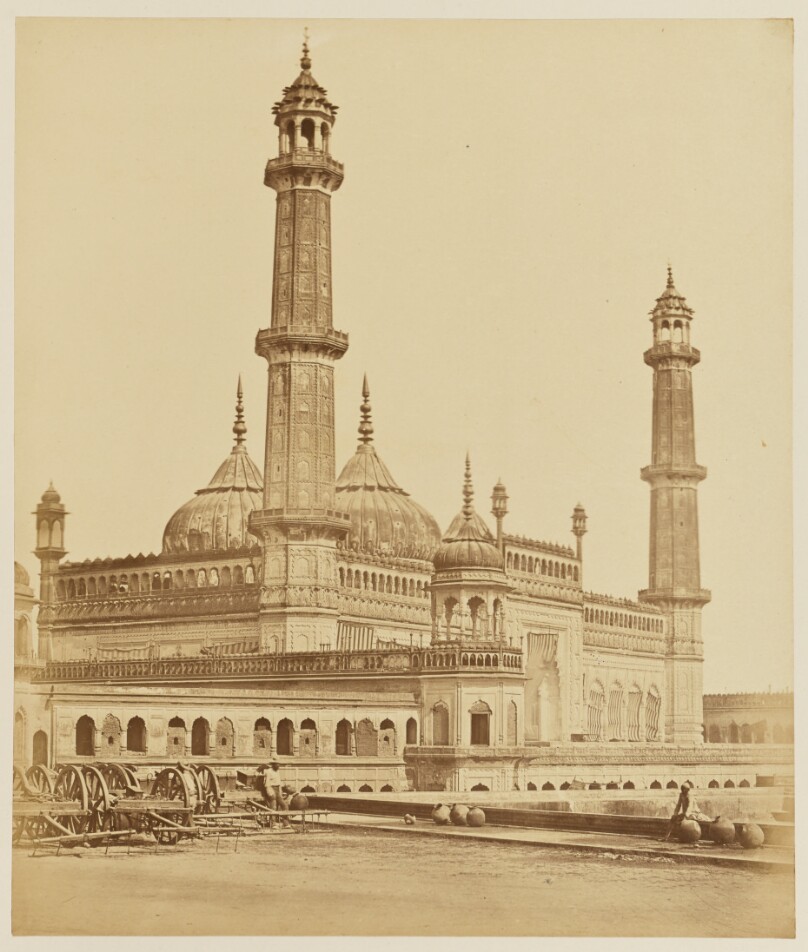
[Mosque inside Asaf-ud Dawlah's Emambara or Tomb, Now Used as a Hospital, Lucknow]
Creator
Felice BeatoPhotographer · 1832–1909
All works by this person →Felice Beato was the first photographer to devote himself entirely to photographing in Asia and the Near East. He photographed in Japan, India, Athens, Constantinople, the Crimea, and Palestine. He settled in Yokohama and from 1863 to 1877 made hundreds of ethnographic portraits and genre scenes in Japan. He eventually opened a furniture and curio business in Burma. Beato's photographic career was
More on Getty ULANObject Description · Getty Museum
Getty Museum’s catalogue record
- produced_by.carried_out_by[0].id
- https://data.getty.edu/museum/collection/person/76341c09-b1ac-4032-85c9-e2cda5493efc
- Artist/Maker
- Felice Beato
- subject_of[Homepage].id
- https://www.getty.edu/art/collection/object/107TDR
- Date
- 1858
- Medium
- Albumen silver print
- Culture
- English
- Object Type
- Print
Taken from LinkedCulture’s stored copy of Getty Museum’s record. A fresh capture of the museum’s own record has not been made for this object yet.
From LinkedCulture
This mosque in Lucknow was photographed just one year after the 1857 uprising, already converted from a place of worship into a British military hospital. Felice Beato captured its twin domes and ornate minarets rising against a pale sky, with artillery carts and ceramic vessels scattered across the courtyard below. Made in 1858 as an albumen silver print, this image is one of the earliest documentary records of war's aftermath ever created, showing exactly how conflict reshapes every institution it touches.
Written by LinkedCulture for its video on this object. Machine-generated (claude-sonnet-4-6), not yet reviewed by a person. It is not part of the museum’s record.
The authoritative record is held by Getty Museum. LinkedCulture surfaces this object and its connections; it does not alter institutional metadata. The fields above are the museum’s, under its own labels. LinkedCulture’s derived fields are listed separately below and marked as ours.
Get printable QR codesHide QR codes
Open QR codes for this object page and the museum record. They stay collapsed until needed.
How LinkedCulture maps this record
To search objects from different museums together, LinkedCulture reads each museum’s record into a common set of fields. The values below are LinkedCulture’s, under LinkedCulture’s names. They are not Getty Museum’s wording; the museum’s own record is shown above under its own labels.
- Object ID
- 54d106a2-55bf-437e-8925-1fa422a45642
- Object Type
- Print
- Getty Museum field “Object Type” · copied as is
- Creator
- Felice Beato
- Getty Museum field “Artist/Maker” · copied as is
- Culture
- English
- Getty Museum field “Culture” · copied as is
- Medium
- Albumen silver print
- Getty Museum field “Medium” · copied as is
- Department
- Photographs
- Getty Museum field “Department” · derived by LinkedCulture from the museum field · Getty's classification category is stored as department.
- Credit Line
- The J. Paul Getty Museum, Los Angeles
- Getty Museum field “Standard Credit Line” · the first available of several museum fields
- Getty Museum field “Source Credit Line” · the first available of several museum fields
- Date
- 1858
- Getty Museum field “Date” · copied as is
- Begin Year
- 1858
- Getty Museum field “produced_by.timespan.begin_of_the_begin” · derived by LinkedCulture from the museum field
- End Year
- 1858
- Getty Museum field “produced_by.timespan.end_of_the_end” · derived by LinkedCulture from the museum field
The museum’s own record has not been captured for this object yet, so the museum fields shown above are limited to values LinkedCulture stored unchanged.
Related across collections
Semantically similar works from Getty Museum and other institutions.