Getty Museum
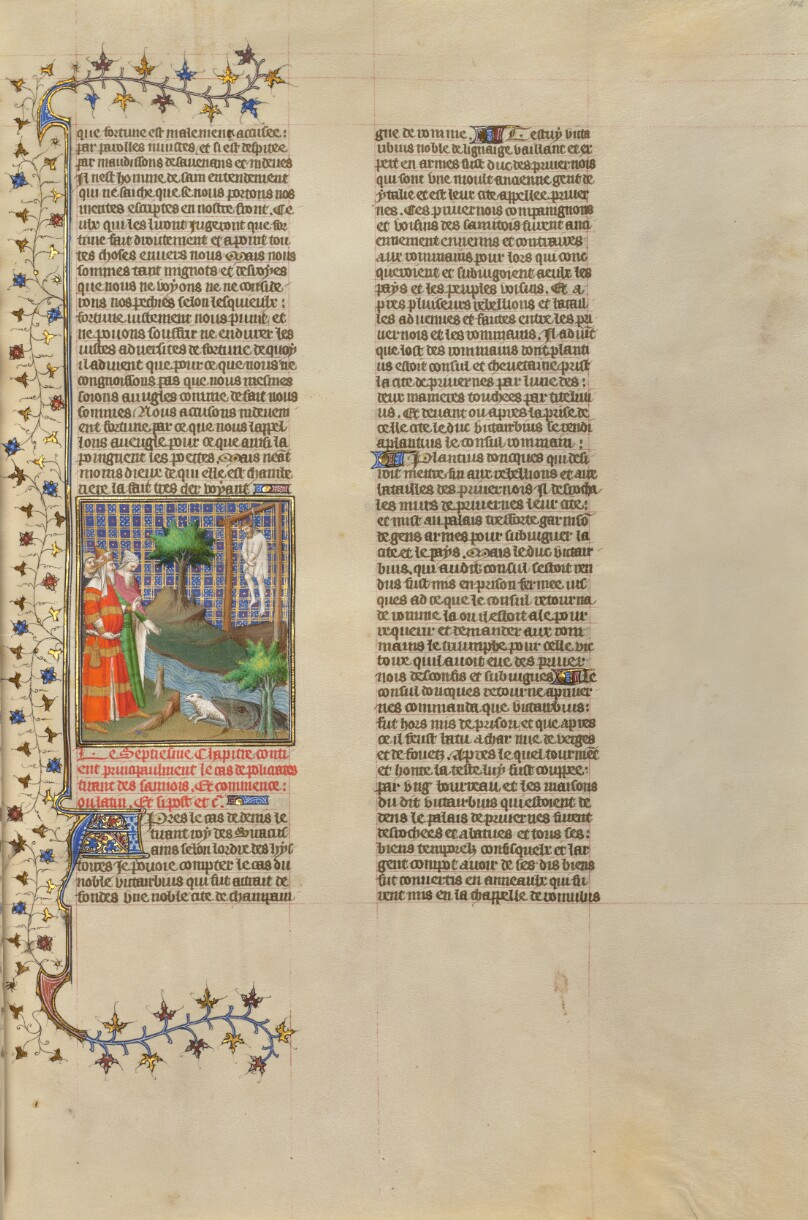
Polycrates Hanged
Creator
Boucicaut MasterFrench Illuminator · 1390–1430
All works by this person →In the early 1400s, the Boucicaut Master was the leading master of manuscript illumination in Paris and one of the most influential artists working in the International style in northern Europe. The Boucicaut Master appears to have supervised a talented team of artists who produced manuscripts commissioned by the king of France, high-ranking aristocrats, and the wealthy bourgeoisie. He probably al
More on Getty ULAN- Date
- about 1413–1415
- Medium
- Tempera colors, gold leaf, gold paint, and ink
- Culture
- French
- Department
- Manuscripts
- Institution
- Getty Museum
- Object ID
- 550339b4-319a-42c5-8d8c-eee44be33089
From the Getty Museum record
Polycrates, the tyrannous ruler of the Aegean island of Samos, stands beside the river into which he tossed a golden ring covered with precious stones, hoping to divert future bad luck. Boccaccio's story tells that he found the ring again in a fish's belly, but the artist or his adviser misinterpreted the story. Confusing the French word for ring, *annel,* with that for lamb, *agnel,* the Boucicaut Master painted the fish returning a lamb to Polycrates instead of his ring. Despite his luck with the ring, a dire fate awaited Polycrates. Seeking to capture the riches of Samos, the Persian governor of Sardis imprisoned Polycrates and had him executed. The artist contrasted Polycrates' hanging with the fortuitous return of the ring. These two scenes succinctly demonstrate the theme of the entire book: the vacillating nature of fortune.
The authoritative record is held by Getty Museum. LinkedCulture surfaces this object and its connections; it does not alter institutional metadata.
Get printable QR codesHide QR codes
Open QR codes for this object page and the museum record. They stay collapsed until needed.
Related across collections
Semantically similar works from Getty Museum and other institutions.