Getty Museum
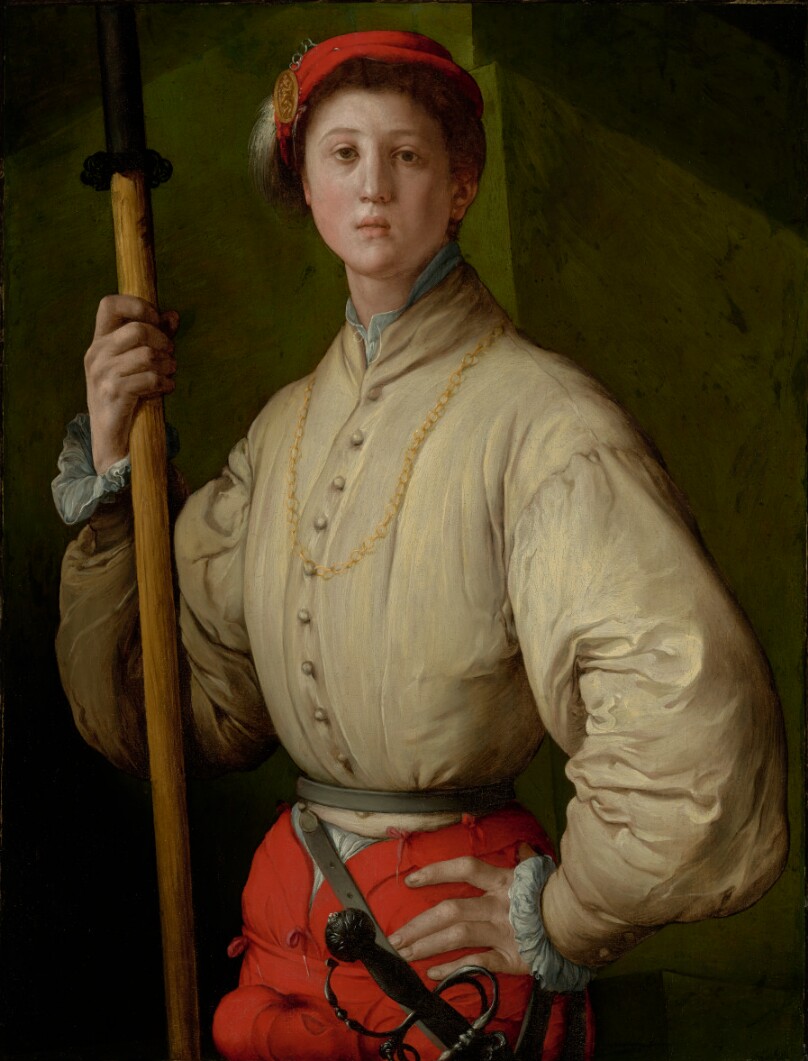
Portrait of a Halberdier (Francesco Guardi?)
Creator
Pontormo (Jacopo Carucci)Italian Artist · 1494–1557
All works by this person →Jacopo Carucci, called Pontormo after the Tuscan town from which he came, was one of the leaders of the Mannerist movement, but as Mannerism increasingly focused on masks and artificiality, there was little room for his keen sensitivity and profound feeling for human states of mind. This quality is unmistakable in the elegant *Portrait of a Halberdier,* which shows Pontormo introducing an insightf
More on Getty ULAN- Date
- 1529–1530
- Medium
- Oil (or oil and tempera) on panel transferred to canvas
- Culture
- Italian
- Department
- Paintings
- Institution
- Getty Museum
- Object ID
- 56016db9-20a4-4a99-814b-23ac542a106e
From the Getty Museum record
Standing before a fortress wall, this well-dressed foot soldier holds a combination spear and battle-axe called a halberd. His direct stare and swaggering pose are strikingly poignant, given the smooth unlined face and slim body that betray him as no more than a teenager. As a portraitist, Jacopo Pontormo was renowned for his subtle, complex psychological studies; here he conveyed the naive arrogance and vulnerability of youth. Court painter to Duke Cosimo de' Medici (1519 – 1574) in Florence, Pontormo pioneered a new, sophisticated type of portraiture which championed elegance and aristocratic reserve. The sitter's identity has been much discussed. The painter and author of the famous [*Lives*](http://primo.getty.edu/GRI:GETTY_ALMA51180320860001551), Giorgio Vasari (1511 – 1574), noted that during the siege of Florence in about 1529, Pontormo painted a "most beautiful work, "a portrait of young nobleman Francesco Guardi as a soldier.” Sure enough, a birth record survives for a male child, Francesco, who was born into the Guardi clan in 1514. This young man would have been around fourteen or fifteen years old at the time of the siege, about the age of Pontormo's teenage sitter. Based on the evidence of a Florentine inventory of the Riccardi family in 1612, it has also been suggested by some that the portrait represents Cosimo de' Medici himself.
The authoritative record is held by Getty Museum. LinkedCulture surfaces this object and its connections; it does not alter institutional metadata.
Get printable QR codesHide QR codes
Open QR codes for this object page and the museum record. They stay collapsed until needed.
Related across collections
Semantically similar works from Getty Museum and other institutions.