Getty Museum
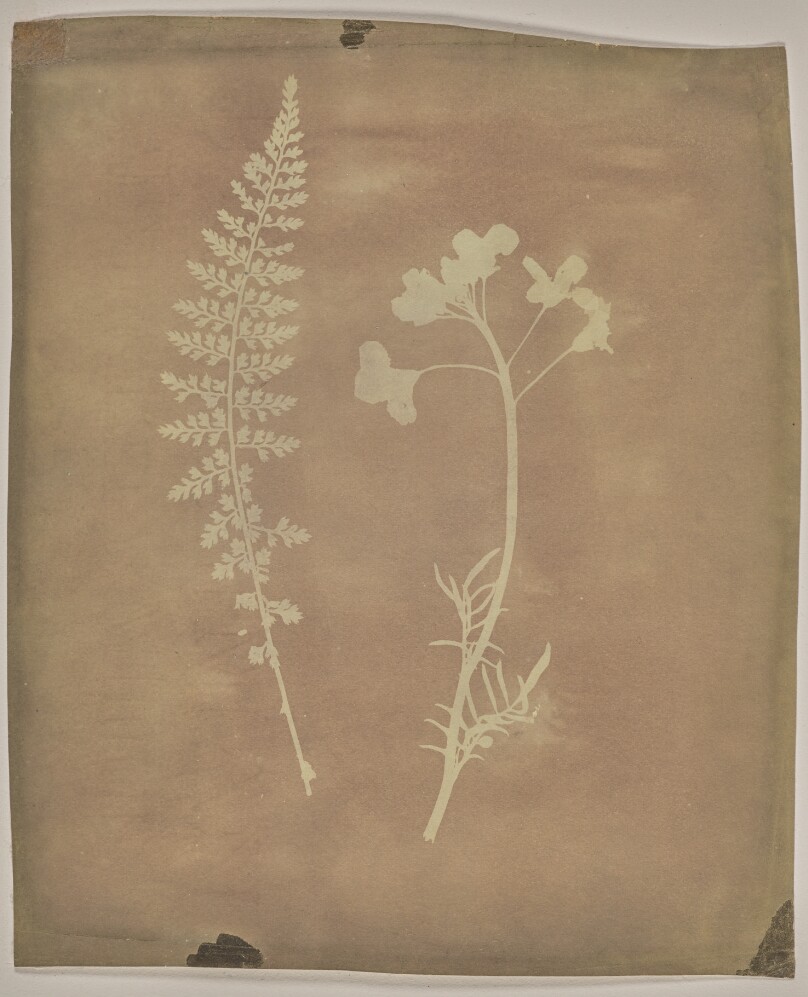
Asplenium Halleri, Grande Chartreuse 1821 - Cardamine Pratensis.
Creator
William Henry Fox TalbotPhotographer · 1800–1877
All works by this person →In 1833, after failed attempts at drawing using the camera lucida, an optical tool, William Henry Fox Talbot wrote: "[H]ow charming it would be if it were possible to cause these natural images to imprint themselves durably, and remain fixed upon the paper!" Talbot, a scientist, mathematician, and author, is credited with being one of the inventors of photography. In mid-1834 he began to experimen
More on Getty ULAN- Date
- April 1839
- Medium
- Photogenic drawing
- Culture
- British
- Department
- Photographs
- Institution
- Getty Museum
- Object ID
- 57cc46af-7755-48a3-9f65-e649cd725348
From the Getty Museum record
> The announcement of photography in the dark depths of winter 1839 severely hampered William Henry Fox Talbot’s efforts to create more examples of his new invention. Light, the very currency of the medium, remained precious in the spring of 1839, but some sunny moments in April finally permitted the production of additional works, such as this splendid image. In keeping with his newly public profile, Talbot proudly and thoroughly titled, signed, and dated this negative in ink before sending it to his aunt Louisa, the marchioness of Lansdowne. The powerful connections of Talbot’s widespread family assisted him greatly in his publicity. Among the influential persons his aunt surely showed this to would have been her friend Sir Augustus Callcott, a marine painter who took an early interest in photography. > > The plant specimens used to make this negative had a special resonance for Talbot and were probably drawn from his own hothouse. In the summer of 1821, having come of legal age and completed his exams at Cambridge, he had set out for a natural history tour of Switzerland, France, and Italy. In July he wrote to his mother that “I have filled my herbarium so full . . . that I have hardly room for anything else.” The following year he received a letter from William Jackson Hooker, the professor of botany at the University of Glasgow, commenting that the plant Talbot sent “from La grande Chartreuse & Grenoble, marked ‘Asplenium’, is the Aspidium Halleri.” [[Read full letter.](http://foxtalbot.dmu.ac.uk/letters/transcriptName.php?bcode=Hook-WJ&pageNumber=9&pageTotal=100&referringPage=0) ] It must have been the descendants of that 1821 specimen that Talbot now preserved in this photographic image. However, it appears that by the time Talbot titled this example he had partially confused Hooker’s expert advice. > > Adapted from Larry Schaaf, *William Henry Fox Talbot*, In Focus: Photographs from the J. Paul Getty Museum (Los Angeles: Getty Publications, 2002), 18. ©2002 J. Paul Getty Trust.
The authoritative record is held by Getty Museum. LinkedCulture surfaces this object and its connections; it does not alter institutional metadata.
Get printable QR codesHide QR codes
Open QR codes for this object page and the museum record. They stay collapsed until needed.
Related across collections
Semantically similar works from Getty Museum and other institutions.