Getty Museum
Burial of Atala
Creator
Anne-Louis Girodet de Roucy-TriosonFrench Artist · 1767–1824
All works by this person →After his father's death in 1784, Anne-Louis Girodet de Roucy-Trioson joined the studio of Neoclassical titan Jacques-Louis David yet became a pioneer of French Romanticism. He won the Prix de Rome in 1789. Girodet's *Endymion Sleeping,* painted in Rome and submitted to the Salon of 1793, showed the influence of Italian artists Antonio Canova and Correggio. Because Girodet's paintings were coldly
More on Getty ULAN- Date
- after 1808
- Medium
- Oil on canvas
- Culture
- French
- Department
- Paintings
- Institution
- Getty Museum
- Object ID
- 5ac22346-341c-4984-83f4-5abfc07faeb7
From LinkedCulture
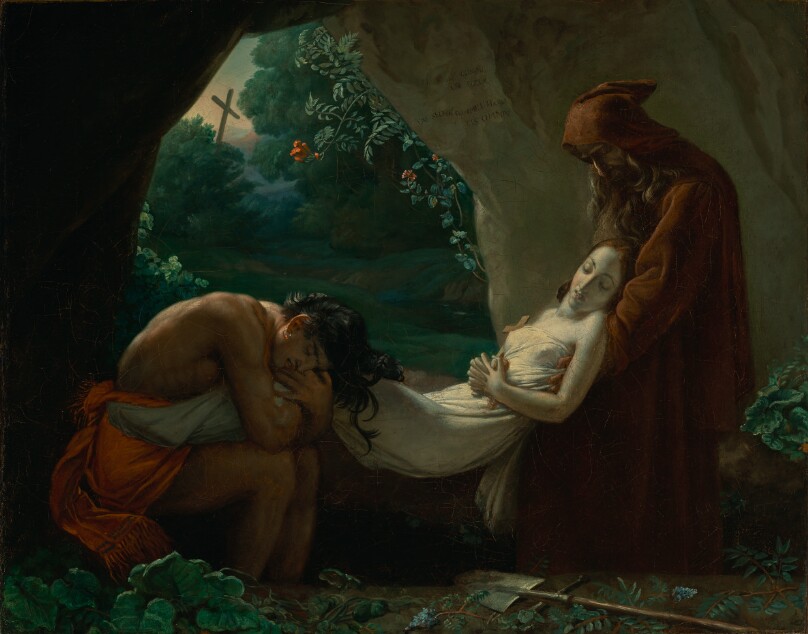
A young woman clutches a crucifix as she lies lifeless between two grieving men in a cave, her white robes glowing against the darkness. This oil on canvas by Anne-Louis Girodet de Roucy-Trioson, painted after 1808, depicts Atala, a fictional Native American Christian girl who chose death over breaking her vow of celibacy. The painting mattered because it arrived just as France restored power to the Catholic Church, fusing religious martyrdom imagery with a romanticized vision of the Americas that captivated a nation fascinated by a world it had never seen.
Written by LinkedCulture for its video on this object. Machine-generated (claude-sonnet-4-6), not yet reviewed by a person. It is not part of the museum’s record.
From the Getty Museum record
Christian sentiment and interest in the Americas were at a high point in France in 1808 when Anne-Louis Girodet de Roucy-Trioson painted his version of *Burial of Atala* and captured both of these popular ideas. The Catholic Church and the French government had recently signed an agreement restoring power to the Church after the French Revolution of the previous two decades had taken it away. At the same time, Christian missionaries, colonial settlers, and explorers were sending their travel accounts back to France and most French people, who would never actually see the Americas, were fascinated by stories from this faraway place. This painting, full of Christian motifs, of the burial of a young girl mourned by her Native American beloved is based on a novella written by Franc¸ois Rene´ Chateaubriand, who had journeyed to North America in 1791. In Chateaubriand’s fictional story set in in the 1700s in the American South (specifically the French-owned Louisiana Territory), the Christian girl Atala made a vow to her mother to remain celibate, and rather than break it for her beloved, a Native American Natchez man named Chactas, she killed herself. In Girodet’s composition, we see Atala’s corpse, sensually draped between the grieving Chactas and the priest who helped them escape a storm, Father Aubry. She is dressed in white, a color symbolizing innocence and purity in European cultures, with a crucifix clutched in her hands. Her pose and the setting in a cave reference common Christian iconography, like scenes of the Entombment and the Deposition that depict Christ after his death. Atala is depicted as saint-like, martyred for her virtue and faith. Chactas’s identity as a Native American is suggested by his comparatively dark complexion, lack of clothing, and long flowing hair, representing an imagined exotic savage in a missionary narrative about “saving” indigenous people with Christianity.
The authoritative record is held by Getty Museum. LinkedCulture surfaces this object and its connections; it does not alter institutional metadata.
Get printable QR codesHide QR codes
Open QR codes for this object page and the museum record. They stay collapsed until needed.
Related across collections
Semantically similar works from Getty Museum and other institutions.