Getty Museum
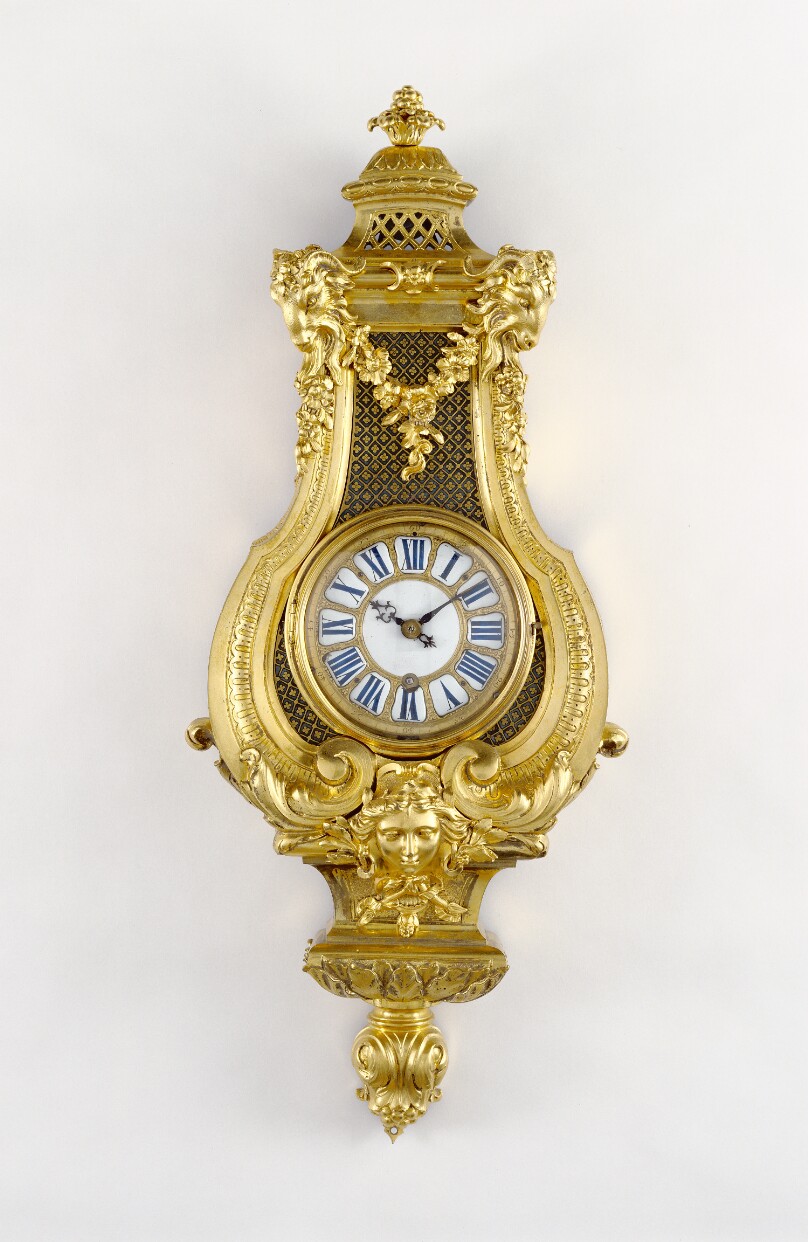
Wall Clock (pendule d'alcove)
Creator
André-Charles BoulleFrench Artist · 1642–1732
All works by this person →Christened by his contemporaries as "the most skillful artisan in Paris," André-Charles Boulle's name is synonymous with the practice of veneering furniture with marquetry of tortoiseshell, pewter, and brass. Although he did not invent the technique, Boulle was its greatest practitioner and lent his name to its common name: boulle work. Boulle also specialized in floral marquetry in both stained a
More on Getty ULAN- Date
- about 1710
- Medium
- Gilt bronze; blue-painted horn; enameled metal
- Culture
- French
- Department
- Decorative Arts
- Institution
- Getty Museum
- Object ID
- 5bcdf743-b18a-4578-8b26-5b98ab11fc7f
From the Getty Museum record
Strings once hung down from the clock through the two holes pierced on each side of this lyre-shaped wall clock. When pulled, they activated a chime that enabled the owner to hear the time in the middle of the night or in a darkened room. Known as a *pendule d'alcove,* this clock would have hung in an alcove above a bed. Appropriately enough for a timepiece, the lyre shape is associated with Apollo, god of the sun. A complex clock such as this one was a collaborative effort on the part of numerous craftsmen, probably in André-Charles Boulle's workshop. The clockmaker, who produced only the movements, would have commissioned a sculptor to design the model, a bronze caster to produce the bronze mounts, and a gilder to chase and gild them. Then an enameler would paint and fire the enamel numbers, each of which was inserted individually.
The authoritative record is held by Getty Museum. LinkedCulture surfaces this object and its connections; it does not alter institutional metadata.
Get printable QR codesHide QR codes
Open QR codes for this object page and the museum record. They stay collapsed until needed.
Part of a LinkedCulture topic
 Decorative Timekeeping Across Cultures
These objects are all ornate clocks from various time periods and regions, showcasing how timekeeping devices served as both functional instruments and decorative art objects across different cultures from the 16th to 19
48 objects from 5 institutions
Related across collections
Semantically similar works from Getty Museum and other institutions.