Getty Museum
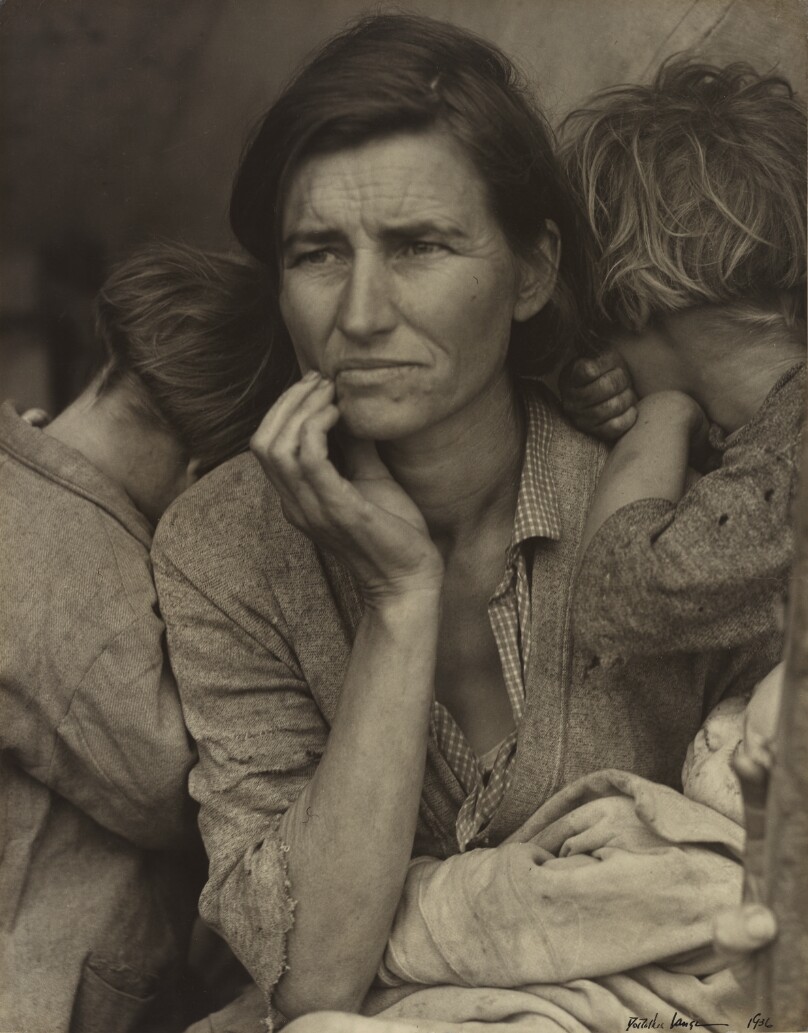
Human Erosion in California (Migrant Mother)
Creator
Dorothea LangeAmerican Photographer · 1895–1965
All works by this person →Born Dorothea Nutzhorn in Hoboken, New Jersey, to first-generation German Americans, Dorothea Lange was stricken at age seven with polio, which left her right leg and foot disfigured. Her father abandoned the family when she was twelve. After high school, she apprenticed with portrait photographer Arnold Genthe in Manhattan and studied with Clarence H. White at Columbia University’s Teacher’s Coll
More on Getty ULAN- Date
- March 1936
- Medium
- Gelatin silver print
- Culture
- American
- Department
- Photographs
- Institution
- Getty Museum
- Object ID
- 5e3e8ca9-7c83-42f5-9739-078d4a0e1266
From the Getty Museum record
> The first publication of this renowned image occurred on March 11, 1936, on the third day that the *San Francisco News* ran a story about the pea pickers' camp in Nipomo. It was also featured as a full-page reproduction in the September 1936 issue of *Survey Graphic*, titled "Draggin'-Around People" and captioned "A blighted pea crop in California in 1935 left the pickers without work. This family sold their tent to get food." Also in this issue was an article by Paul Taylor, Dorothea Lange's husband, entitled "From the Ground Up." His report on demonstration projects of the New Deal's Resettlement Administration (RA) in Arizona, Utah, New Mexico, and California was illustrated with four more pictures by Lange. > > Since it was first published, this composition, best known as *Migrant Mother*, has come to represent not only the pictorial archive created by the RA/Farm Security Administration during the 1930s, but also the Great Depression itself. Posters and other publicity of later activists fighting racial, economic, and political oppression have borrowed from Lange's icon of the time. The handsome, androgynous face, the pose of stoic anxiety, and the encumbrance of three children proved to be universal attributes. Lange took five other shots of Owens on that same day. The Getty has one more from this group in its collection ([2001.51.1](http://www.getty.edu/art/collection/objects/130790)). With Lange's artistry, Florence Owens took on the timeless quality of Eugène Delacroix's strong female rebel (*[Liberty Leading the People](https://www.louvre.fr/en/oeuvre-notices/july-28-liberty-leading-people)*) and Jean-François Millet's [peasant woman](https://www.metmuseum.org/art/collection/search/437099) (the agrarian ideal), Honoré Daumier's [laundresses](https://www.metmuseum.org/art/collection/search/436091) (the working woman), and K?the Kollwitz's proletarian woman warrior (one of the mothers leading her *Peasant's War*). > > Owens, although, she became famous, did not enjoy, even momentarily, the life of a celebrity. She had a total of ten children and kept moving with her family, following the California crops. She did become involved in efforts to organize farm labor and would sometimes serve as the straw boss, one who negotiates wages for the migrants as the picking season begins. She was still working in the fields at the age of fifty before finally marrying again (to George Thompson) and settling down into a stable life in Modesto, California. Judith Keller, *Dorothea Lange,* In Focus: Photographs from the J. Paul Getty Museum (Los Angeles: J. Paul Getty Museum, 2002), 32. © 2002 J. Paul Getty Trust.
The authoritative record is held by Getty Museum. LinkedCulture surfaces this object and its connections; it does not alter institutional metadata.
Get printable QR codesHide QR codes
Open QR codes for this object page and the museum record. They stay collapsed until needed.
Related across collections
Semantically similar works from Getty Museum and other institutions.