Getty Museum
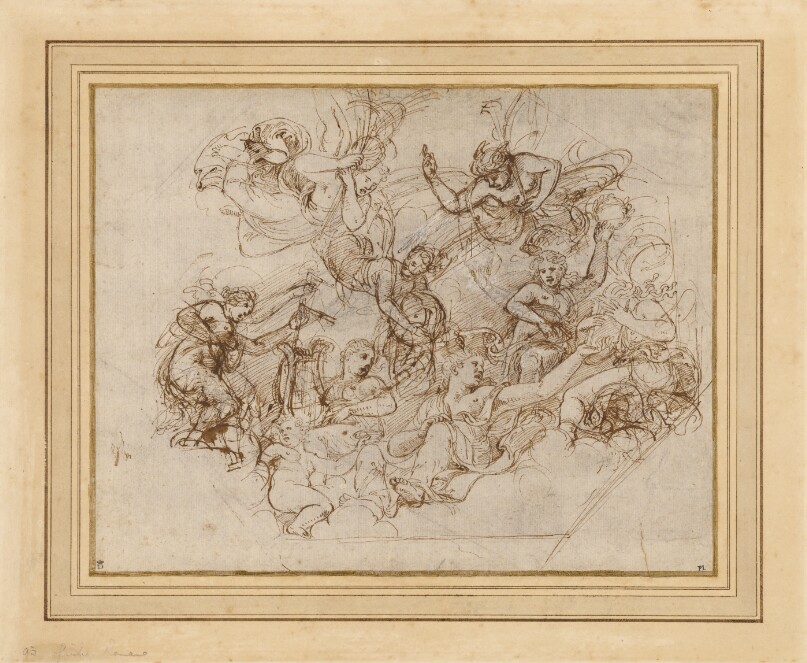
An Allegory of the Virtues of Federico II Gonzaga
Creator
Giulio Romano (Giulio Pippi)Italian Artist · 1499–1546
All works by this person →Giulio Romano was so famous in the century after his death that he is the only "modern" artist mentioned by Shakespeare in a play. A Roman native, by about 1515 he was working for Raphael in the Vatican, eventually becoming the master's most trusted aide. Raphael's late works indicate the increasing torsion and tension that Mannerist artists like Giulio would bring to full flower, ideas that Giuli
More on Getty ULAN- Date
- about 1530
- Medium
- Pen and brown ink with black chalk, with corrections by the artist in opaque white watercolor
- Culture
- Italian
- Department
- Drawings
- Institution
- Getty Museum
- Object ID
- 5e59b1e5-159a-497e-9623-57f822f08d8e
From the Getty Museum record
Seated on the edge of a cloud, in the center of the bottom of this drawing, a personification of the city of Mantua reaches out to receive a book from another figure at the right. Others circle above her holding in their hands such attributes as a globe, a lute, and a wreath. The god Mercury, identifiable by his winged helmet, hovers in the upper right corner. Giulio Romano produced this design as a study for his patron Federico II Gonzaga's Palazzo del Tè, outside of Mantua. Intended to glorify Federico and his reign, it presents the central ceiling fresco of an addition to the palazzo. The numerous pentimenti in the drawing show that Giulio continued to experiment with the arrangement of the figures. For example, the right arm of the woman with a wreath was originally extended, holding a book. The figure on the far left, whose left arm reaches towards the center, was originally drawn slightly higher.
The authoritative record is held by Getty Museum. LinkedCulture surfaces this object and its connections; it does not alter institutional metadata.
Get printable QR codesHide QR codes
Open QR codes for this object page and the museum record. They stay collapsed until needed.
Related across collections
Semantically similar works from Getty Museum and other institutions.