Getty Museum
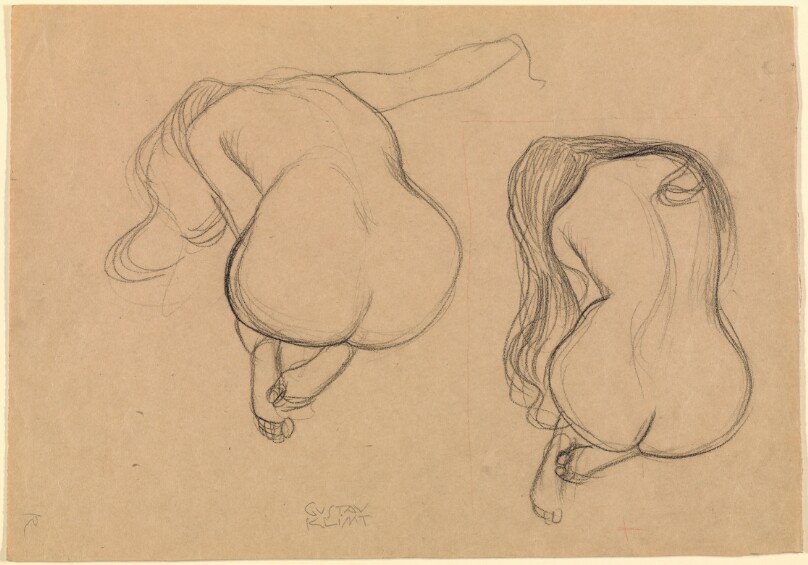
Two Studies of a Seated Nude with Long Hair
Creator
Gustav KlimtAustrian Artist · 1862–1918
All works by this person →Gustav Klimt is known for his sumptuous, ornate paintings in which the figures are nearly submerged in a mosaic of jewel-like color and gold. He was also a highly accomplished and prolific draftsman. For drawings, Klimt preferred to work in black chalk and pencil, monochrome media which draw attention to the extreme refinement and intensity of his line. The son of an engraver, Klimt entered the Vi
More on Getty ULAN- Date
- about 1901–1902
- Medium
- Black chalk and red pencil
- Culture
- Austrian
- Department
- Drawings
- Institution
- Getty Museum
- Object ID
- 5e869b2a-3b4a-4f2b-83d0-a3e904953bdf
From the Getty Museum record
Gustav Klimt's favored working practice was somewhat unorthodox: he employed a number of nude models who lounged around his studio striking spontaneous poses, which he captured with a few exquisitely economical strokes of chalk or pencil. Many such life studies remained independent works of art, but others inspired paintings. These sketches of a kneeling woman, her generous buttocks thrust toward the viewer and her luxuriant hair cascading around her head as if caught by a current of air or water, ultimately served as preparatory drawings for the foreground figure in Klimt's painting *Goldfish* (now in the Kunstmuseum Solothurn, Switzerland). In the finished painting, the nude retains this pose but turns her head to gaze impudently over her shoulder; Klimt initially titled it "To my critics" in reference to the controversy over three highly erotic murals he painted for the University of Vienna which had been attacked by the conservative press. The fluid, stylized treatment of the model's body and hair, which verges on abstraction, suggests his enduring identification of women with water--unbounded, immaterial and elusive--a common motif in his work. Although this drawing served as a study for another work, Klimt seems to have considered it a work of art in its own right. Not only did he sign it, he also published a reproduction of the right-hand figure in the Vienna Secession periodical *Ver Sacrum* in 1902; faint red pencil marks--cropping indications for the photographer--frame the figure. The drawing is housed in a facsimile of a frame designed by Klimt himself, exemplifying his commitment to the idea of the *Gesamtkunstwerk* (total work of art).
The authoritative record is held by Getty Museum. LinkedCulture surfaces this object and its connections; it does not alter institutional metadata.
Get printable QR codesHide QR codes
Open QR codes for this object page and the museum record. They stay collapsed until needed.
Related across collections
Semantically similar works from Getty Museum and other institutions.