Getty Museum
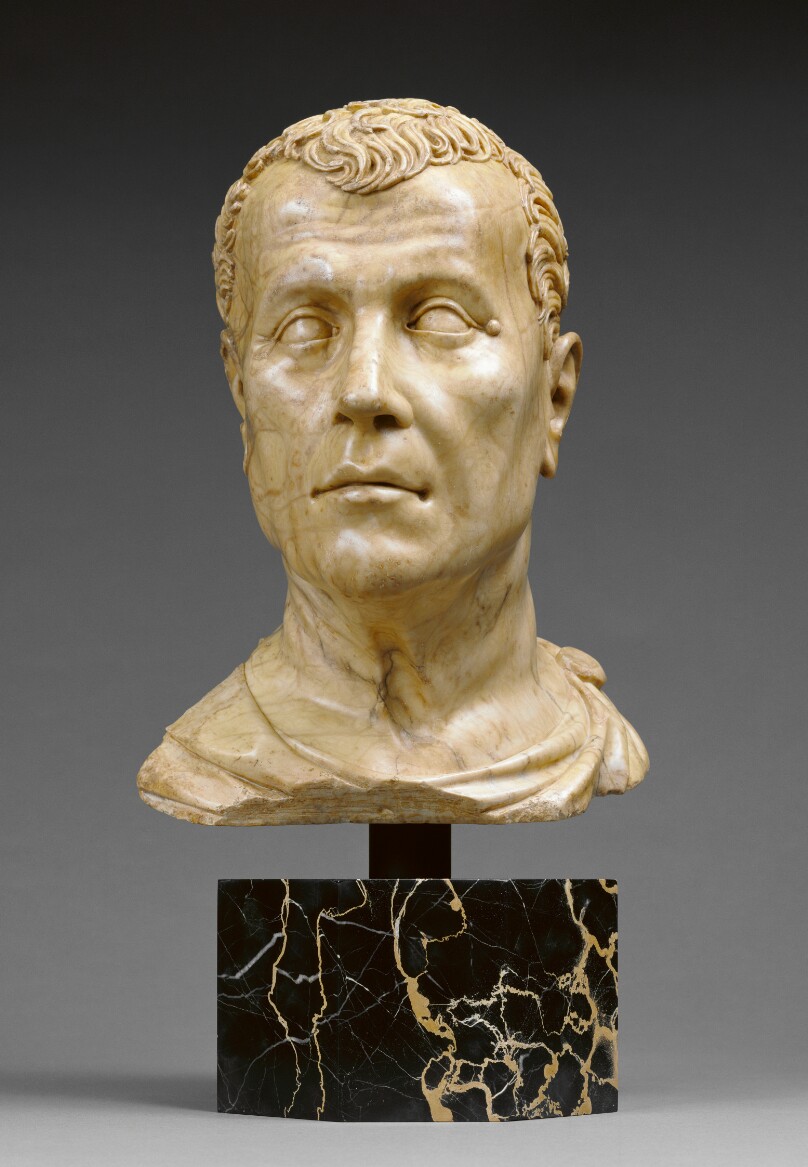
Head of a Man (possibly a portrait of Cicero, 106 - 43 B.C.)
Creator
Conrat MeitGerman Artist · 1480–1550
All works by this person →One of the most important sculptors of the German Renaissance, Conrat Meit was influenced by antique culture and by the German tradition of detailed naturalism. Meit probably trained in Lucas Cranach the Elder's workshop, and by 1511 he was working in Wittenberg for the Saxon Elector Friedrich the Wise. This learned patron also employed Cranach and Albrecht Dürer. In 1514 Meit was named official c
More on Getty ULAN- Date
- 1515–1520
- Medium
- Alabaster
- Culture
- German
- Department
- Sculpture
- Institution
- Getty Museum
- Object ID
- 5ee28855-a627-493f-9ca0-4a31a2261e36
From the Getty Museum record
The stern-faced man looking slightly off to his right with noble bearing strikes the viewer with his forthrightness and candor. The deep crow's feet, creased forehead, and sagging skin suggest a mature age, while his modest, short-cropped hair and the lack of ornamentation speak of a stoic conservatism. Above all, the representation establishes the sitter's moral authority. The distinctive mole at the corner of the left eye suggests that the subject is Cicero, the famous Roman orator, statesman, lawyer, and poet. According to the Roman historian Plutarch, Cicero's name derived from a description of the mole in Latin as *cicer,* or chickpea, a feature of the subject which became standard in Renaissance depictions. German Renaissance sculptor Conrat Meit carved the *Head of a Man* in emulation of busts from the Roman Republican period; this period favored a stark style with unmarked eyeballs and forward-combed hair. The starfish pattern on the back of the head is also typical of ancient busts. This kind of bust, which has been reset on a modern support, would have probably decorated the interior of a noble residence.
The authoritative record is held by Getty Museum. LinkedCulture surfaces this object and its connections; it does not alter institutional metadata.
Get printable QR codesHide QR codes
Open QR codes for this object page and the museum record. They stay collapsed until needed.
Related across collections
Semantically similar works from Getty Museum and other institutions.