Getty Museum
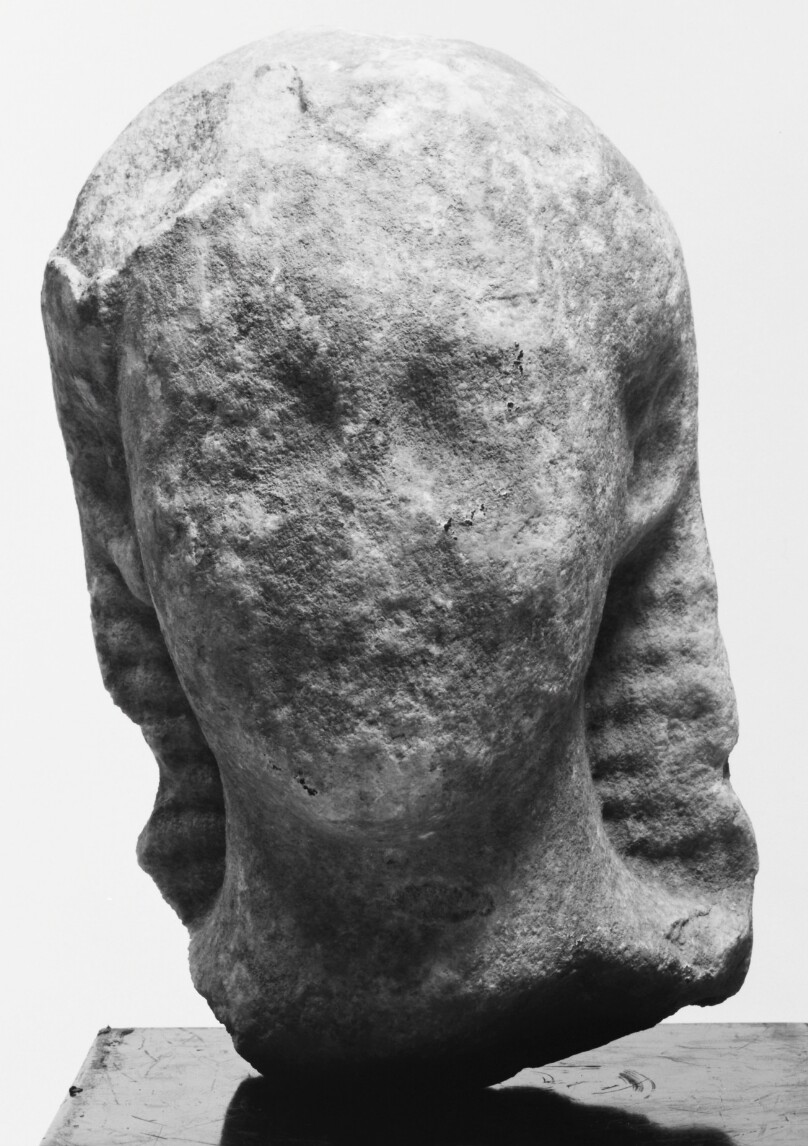
Head of a Kouros
Creator
UnknownAll works by this person →More on Getty ULAN- Date
- about 530 B.C.
- Medium
- Marble
- Culture
- Greek
- Department
- Sculpture
- Institution
- Getty Museum
- Object ID
- 5fa2d8f6-4996-4636-b45e-5f42307f25f7
From the Getty Museum record
Broken from a full-standing kouros (young man), this head preserves part of the curve of the shoulder on the figure’s left side; the right side ends at the bottom of the neck. Because of extensive damage, the features of the face and the long strands of hair can be read only in shadowy traces. Examination under a raking light, however, reveals that the eyes were set rather deeply, especially at the inner corners, slanting upward slightly toward the outside beneath arched brows. Vertical grooves that mark the corners of the mouth are also visible. The rendering of the hair is distinctive. A layer of short, fine hair swept back from the face over the temples and ending just above the backs of the ears overlays the eighteen longer strands that fall below the shoulders. The long locks are incised vertically and then divided horizontally with shallow grooves to create an effect of regular wavy undulations. The unique treatment of the hair on this kouros places it with examples from East Greece, which also feature a layered hairstyle with short strands brushed back from the hairline and over the ears. The Getty’s head may have belonged to a kouros produced in the region of southwestern Anatolia, perhaps the city of Didyma.The ancient Greek word for youth, kouros, was adopted by modern scholars for statues of the Archaic period of sexually mature young men usually depicted nude. The pose of the statues follows a convention of standing frontally with the left leg forward, the weight evenly distributed, arms at the sides with the head perfectly aligned with the body and eyes looking straight ahead. There is great variation in the sizes of kouroi. Some are small bronze statuettes, while others are colossal marble figures. Statues of kouroi were erected as grave markers and as votive offerings in sanctuaries, in some instances representing divinities themselves. Distribution of this statue type is most prevalent in Attica and Boeotia on mainland Greece, the Cycladic islands, especially Naxos and Delos, and sites in East Greece, most notably Samos and Didyma.
The authoritative record is held by Getty Museum. LinkedCulture surfaces this object and its connections; it does not alter institutional metadata.
Get printable QR codesHide QR codes
Open QR codes for this object page and the museum record. They stay collapsed until needed.
Related across collections
Semantically similar works from Getty Museum and other institutions.