Getty Museum
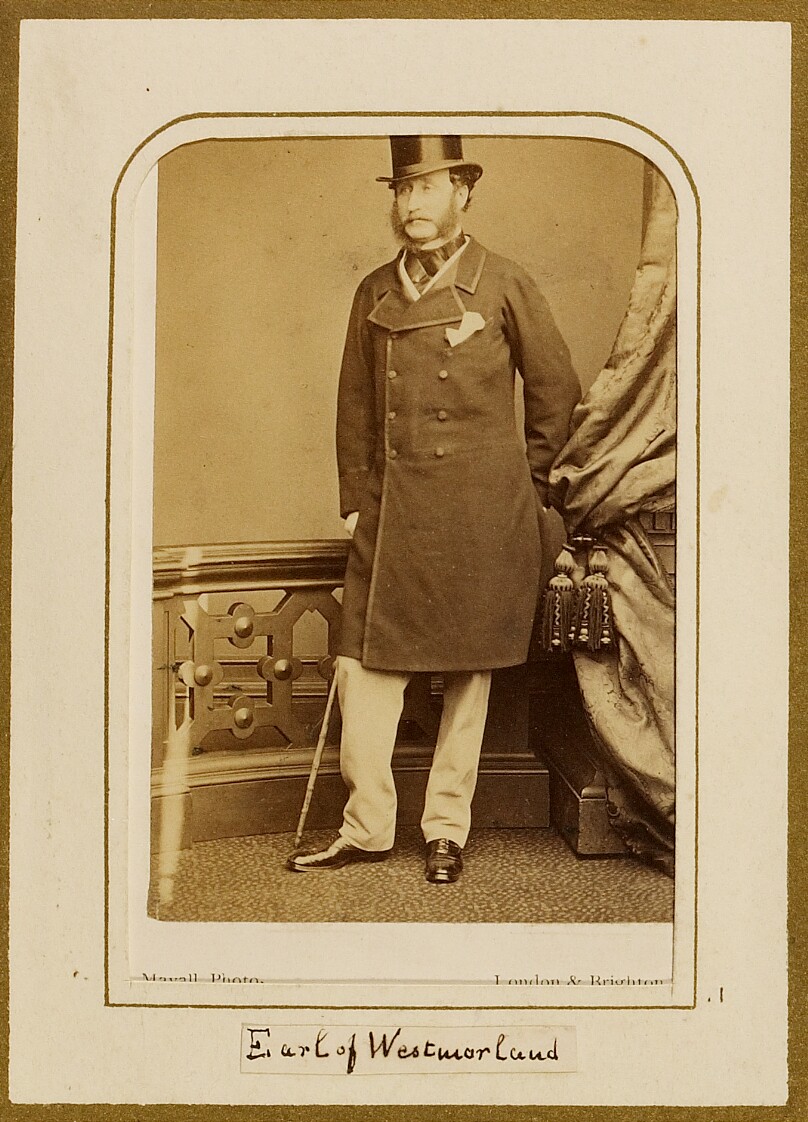
Earl of Westmorland
Creator
John Jabez Edwin MayallPhotographer · 1813–1901
All works by this person →After serving as the proprietor of a daguerreotype studio and a chemistry lecturer in Philadelphia, Pennsylvania, John Jabez Edwin Mayall relocated to London in 1846. He promptly obtained a daguerreotypist's license from Richard Beard, who at that time held the patent for the process in England. In April 1847 Mayall opened the American Daguerreotype Institution in London, explicitly naming it Amer
More on Getty ULAN- Date
- about 1864
- Medium
- Albumen silver print
- Culture
- British
- Department
- Photographs
- Institution
- Getty Museum
- Object ID
- 607c2a5d-5446-4039-8f66-9e488bac8396
From the Getty Museum record
Victorian collagists were typically upper-class women. They took their photographic materials primarily from cartes-de-visite. Patented by André Adolphe Eugène Disdéri in 1854, the _carte-de-visite_ was easily and inexpensively printed ([84.XD.1157.2179](https://www.getty.edu/art/collection/object/107JXY)). By the 1860s, _cartomania _had taken hold. It became customary to exchange _cartes-de-visite _ when calling upon friends and family. These small portraits measure 3 ½ x 2 1/8 inches, about the size of a playing card. It is not known whether these artists removed the photographs from the thick cardstock on which they had been mounted or obtained unmounted prints from the photographer. People also collected cards of the royal family, actors, and politicians (for an example, see this image of Princess Christina of the United Kingdom found in this album ([84.XD.1283.36](https://www.getty.edu/art/collection/object/107NCC)). A woman’s collection of _cartes-de-visite_ visually displayed her social circle and favorite celebrities. This photograph sits in an album that intermixes pages of unaltered _cartes-de-visite_ with full page photocollages. The _cartes-de-visite_ could be inserted in specially manufactured album pages that came with slots. The album’s compiler/collagist might add painted ornamentation to the slotted pages, as in this first page from _The Westmorland Album_. (Click on the alternate image above) This album was given the title The Westmorland Album at some point in its life because the portraits of the Earl and Countess of Westmorland appear at the top of its first page of photographs. However, the likely owner and compiler was recently identified by curators at the Art Institute of Chicago. The initials “VAY” found on the well-preserved red leather album cover ([84.XD.1283](https://www.getty.edu/art/collection/object/1040P3) cover) and in the watercolor design on the opening page suggest that Victoria Alexandrina Hare Anderson-Pelham, Countess of Yarborough (also known as Lady Yarborough, 1840-1927), assembled the album and made some of the compositions. She was the goddaughter and namesake of Queen Victoria. The countess is depicted in several other photographs and collages in the album ([84.XD.1283.30](https://www.getty.edu/art/collection/object/107NC6), [84.XD.1283.160](https://www.getty.edu/art/collection/object/107NG6)). Her niece Eva Macdonald (1846/50-1930) also created at least two of the collages. ([84.XD.1283.34](https://www.getty.edu/art/collection/object/107NCB) and [84.XD.1283.161](https://www.getty.edu/art/collection/object/107NG7)). Thus, this album presents a rare instance where the compiler and artist, for at least some of the photocollages, has been identified. Carolyn Peter, J. Paul Getty Museum, Department of Photographs 2021 For more information about this album see the extended essay.
The authoritative record is held by Getty Museum. LinkedCulture surfaces this object and its connections; it does not alter institutional metadata.
Get printable QR codesHide QR codes
Open QR codes for this object page and the museum record. They stay collapsed until needed.
Related across collections
Semantically similar works from Getty Museum and other institutions.