Getty Museum
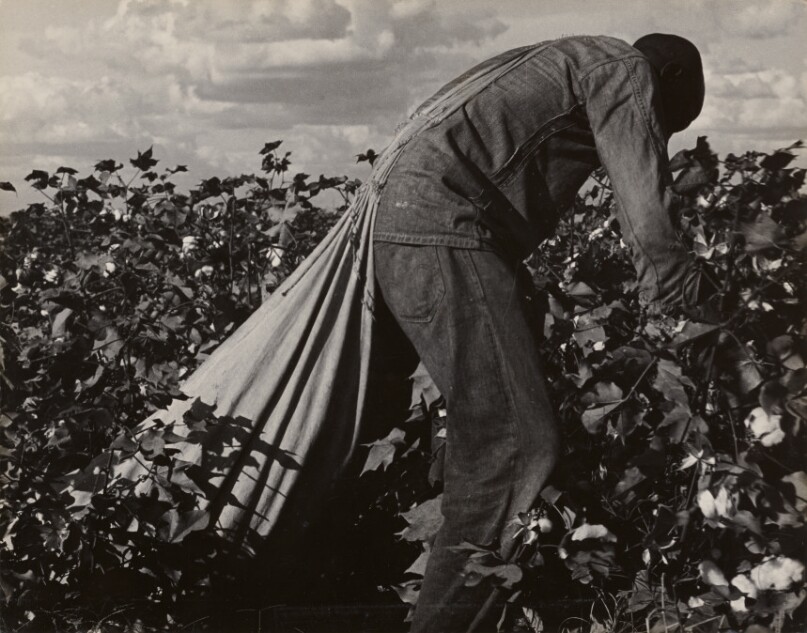
Stoop Labor in Cotton Field, San Joaquin Valley, California
Creator
Dorothea LangeAmerican Photographer · 1895–1965
All works by this person →Born Dorothea Nutzhorn in Hoboken, New Jersey, to first-generation German Americans, Dorothea Lange was stricken at age seven with polio, which left her right leg and foot disfigured. Her father abandoned the family when she was twelve. After high school, she apprenticed with portrait photographer Arnold Genthe in Manhattan and studied with Clarence H. White at Columbia University’s Teacher’s Coll
More on Getty ULAN- Date
- 1938
- Medium
- Gelatin silver print
- Culture
- American
- Department
- Photographs
- Institution
- Getty Museum
- Object ID
- 60f2f5df-ebec-4b53-8e27-98e1a91c1dde
From the Getty Museum record
> *An American Exodus: A Record of Human Erosion* was published by Dorothea Lange and Paul Taylor in 1939 as a collaborative effort between "a photographer and a social scientist." The book was divided into six sections—Old South, Plantation under the Machine, Midcontinent, Plains, Dust Bowl, and Last West—each containing a portfolio of captioned images by Lange followed by a historical text by Taylor. The pictures in the first section consisted of field laborers and poor homes photographed in Alabama and Georgia. The anonymous cotton picker seen here serves to illustrate Taylor's essay, appearing just above his opening paragraph. Lange's view of the man's form make this difficult, exhausting work look graceful; the coarse cloth of his overalls and heavy bag crease and hang in beautiful ways. > > In the revised and expanded edition of *An American Exodus*, issued by the Oakland Museum in 1969, this picture is accompanied by a caption from Taylor's field notes from the San Joaquin Valley in November 1938: "Migratory cotton picker paid 75 cents per 100 pounds. A good day's pick is 200 pounds. CIO union strikers demand $1 per 100 pounds." According to *The WPA Guide to California*, the state had been producing an important variety of cotton (Alcala) since it was introduced in 1917; in 1937 the average yield per acre was nearly twice that of the rest of the country. Although Lange did photograph workers planting and harvesting cotton in Southern states, this image was actually made of a migrant laborer in California. > > The work of picking cotton occupies a chapter of John Steinbeck's *The Grapes of Wrath*. Like other seasonal labor, it was a possibility for the Joad family, who had fled the dust bowl conditions of Oklahoma. In a conversational style, seemingly from the migrant picker's viewpoint, Steinbeck describes the process: "Now the bag is heavy, boost it along. Set your hips and tow it along, like a work horse. . . . Good crop here. Gets thin in low places, thin and stringy. Never seen no cotton like this here California cotton." Judith Keller, *Dorothea Lange,* In Focus: Photographs from the J. Paul Getty Museum (Los Angeles: J. Paul Getty Museum, 2002), 36. © 2002 J. Paul Getty Trust.
The authoritative record is held by Getty Museum. LinkedCulture surfaces this object and its connections; it does not alter institutional metadata.
Get printable QR codesHide QR codes
Open QR codes for this object page and the museum record. They stay collapsed until needed.
Related across collections
Semantically similar works from Getty Museum and other institutions.