Getty Museum
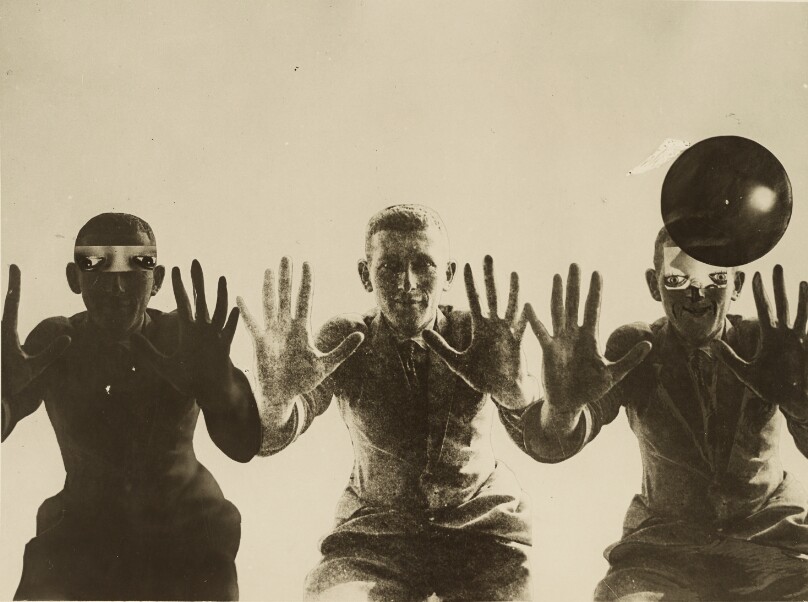
Die Transformierung
Creator
László Moholy-NagyAmerican Photographer · 1895–1946
All works by this person →> The reality of our century is technology: the invention, construction and maintenance of machines. To be a user of machines is to be of the spirit of this century. Machines have replaced the transcendental spiritualism of past eras. > > --László Moholy-Nagy > > Perhaps more than any other artist in the Getty Museum collection, László Moholy-Nagy would have delighted in the presentation of his im
More on Getty ULAN- Date
- 1925
- Medium
- Gelatin silver print
- Culture
- American
- Department
- Photographs
- Institution
- Getty Museum
- Object ID
- 6139d324-4155-47b5-abb3-1440a625d2e9
From the Getty Museum record
> Photography’s capacity for reproduction made it possible to produce several variants of a piece, as seen in a series begun in 1925 and featuring variations of a portrait of Marcel Breuer. The Getty Museum’s collection includes five prints from this series. Breuer was a student at the Bauhaus who subsequently was appointed head of the furniture workshop in April 1925. Like László Moholy-Nagy, Breuer was born in Hungary and was a close ally of Walter Gropius, the head of the Bauhaus. Breuer later became a celebrated architect. > > In *The Law of the Series* ([84.XM.997.4](http://www.getty.edu/art/collection/objects/46588/laszlo-moholy-nagy-the-law-of-the-series-american-1925/)) Moholy seems to be experimenting with the dynamic potential of the repeated image, flopping the negative back and forth to produce five versions of Breuer augmented by a focal circle and receding curved lines. In the variant print *The Transformation/Anxiety Dream*, 1925 ([84.XM.997.43](http://www.getty.edu/art/collection/objects/46627/laszlo-moholy-nagy-the-transformation-anxiety-dream-american-1925/)), Breuer’s figure is again repeated, but altered by the addition of a ball and upside-down eyes from other faces (one pair belonging to the silent film star Mae Murray). Pencil lines around the figures indicate cropping for this print, in which the three Breuers are enlarged and the white space around them is eliminated. The disturbing eyes in this version perhaps gave rise to the ambiguous alternate title *Anxiety Dream.* Ultimately, Moholy-Nagy adapted the series to advertise the Schocken Department Store in Nuremberg. The Getty collection includes one version with red lettering ([84.XM.997.2](http://www.getty.edu/art/collection/objects/46586/laszlo-moholy-nagy-plakat-fur-das-kaufhaus-schocken-american-1927/)) and another without text ([84.XM.997.3](http://www.getty.edu/art/collection/objects/46587/laszlo-moholy-nagy-the-law-of-the-series-american-1925/)). The lines of force and the arrow unerringly convey the viewer to the store pictured in the upper-right-hand corner of the composition. Breuer becomes an economic traffic cop as he commands: “Stop! Have you been to the Schocken Department Store yet?” > > Adapted from Katherine Ware, *László Moholy-Nagy*, In Focus: Photographs from the J. Paul Getty Museum (Los Angeles: J. Paul Getty Museum, 1995), 38. © 1995 The J. Paul Getty Museum.
The authoritative record is held by Getty Museum. LinkedCulture surfaces this object and its connections; it does not alter institutional metadata.
Get printable QR codesHide QR codes
Open QR codes for this object page and the museum record. They stay collapsed until needed.
Related across collections
Semantically similar works from Getty Museum and other institutions.