Getty Museum
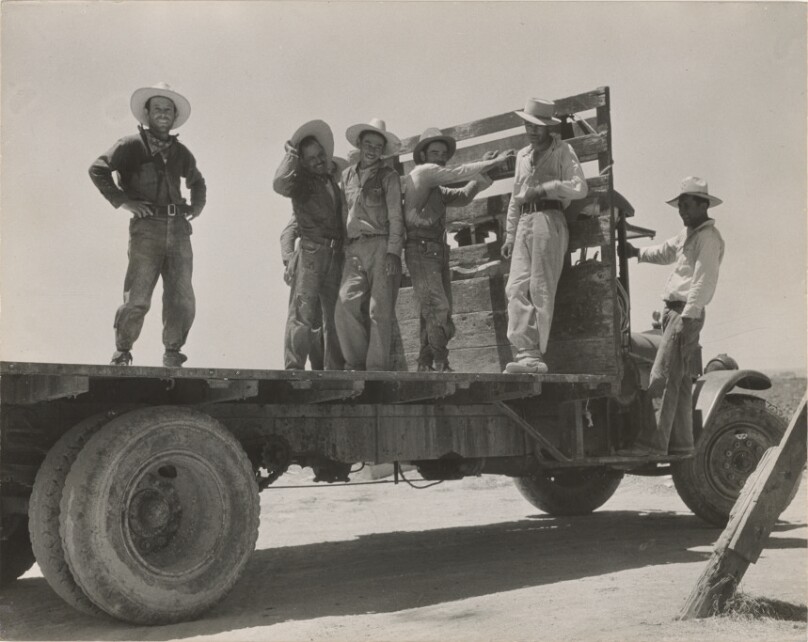
Cantaloupe Pickers, Mexicans, at End of Day in California Melon Fields / Mexican Labor Off for the Melon Fields in the Imperial Valley, California
Creator
Dorothea LangeAmerican Photographer · 1895–1965
All works by this person →Born Dorothea Nutzhorn in Hoboken, New Jersey, to first-generation German Americans, Dorothea Lange was stricken at age seven with polio, which left her right leg and foot disfigured. Her father abandoned the family when she was twelve. After high school, she apprenticed with portrait photographer Arnold Genthe in Manhattan and studied with Clarence H. White at Columbia University’s Teacher’s Coll
More on Getty ULAN- Date
- July 1935
- Medium
- Gelatin silver print
- Culture
- American
- Department
- Photographs
- Institution
- Getty Museum
- Object ID
- 61f8edf7-3c5b-46a1-8fef-a4f12256865c
From the Getty Museum record
> Dorothea Lange met economics professor Paul Schuster Taylor in 1934 when her photographs of labor leaders, May Day demonstrators, and breadline recipients ([2000.43.1](http://www.getty.edu/art/collection/objects/129301)) were on view in her first one person show at her friend Willard Van Dyke's studio. Taylor would become Lange's professional partner and in 1935, her second husband. For Taylor, pictures were as important as statistics and analysis; his research methodology included photography from 1927 on. However, before he met Lange, the pictures that he used were his own. Taylor's young family was his first subject in the 1920s, but, apparently inspired by the combination of text and images in the social welfare journal that had published much of Lewis Hine's innovative documentary work—*Survey Graphic*—he chose to take his Kodak with him when he began the study of Mexican migrants. Van Dyke also exhibited the economist's prints at about the same time. Once a team in the field, Lange made the photographs with her more professional equipment (various Graflex, Rolleiflex, and view cameras) while Taylor continued his interviews with farm workers. > > Taylor was raised in western Iowa and attended the University of Wisconsin before doing graduate work at the University of California, Berkeley. He received a Ph.D. in labor economics there in 1922 for his study of merchant seamen. For the next forty years he taught in the economics department, becoming a full professor in 1939. His fieldwork on Mexican immigration began in 1927 with research money from the Social Science Research Council and the Guggenheim Foundation. The results of the study were published as the multivolume *Mexican Labor in the United States* (1928-34). In the early 1930s he started contributing articles to a variety of scholarly journals and progressive publications, including *Rural Sociology, Monthly Labor Review, Survey Graphic,* and *American Sociological Review.* In addition, his concern with being in the field, or "on the ground" as he called it, led him to involvement with the Rural Rehabilitation Division of the California Emergency Relief Administration, the Resettlement Administration, and the Social Security Board. Adapted from Judith Keller, *Dorothea Lange,* In Focus: Photographs from the J. Paul Getty Museum (Los Angeles: J. Paul Getty Museum, 2002), p. 22. © 2002 J. Paul Getty Trust.
The authoritative record is held by Getty Museum. LinkedCulture surfaces this object and its connections; it does not alter institutional metadata.
Get printable QR codesHide QR codes
Open QR codes for this object page and the museum record. They stay collapsed until needed.
Related across collections
Semantically similar works from Getty Museum and other institutions.