Getty Museum
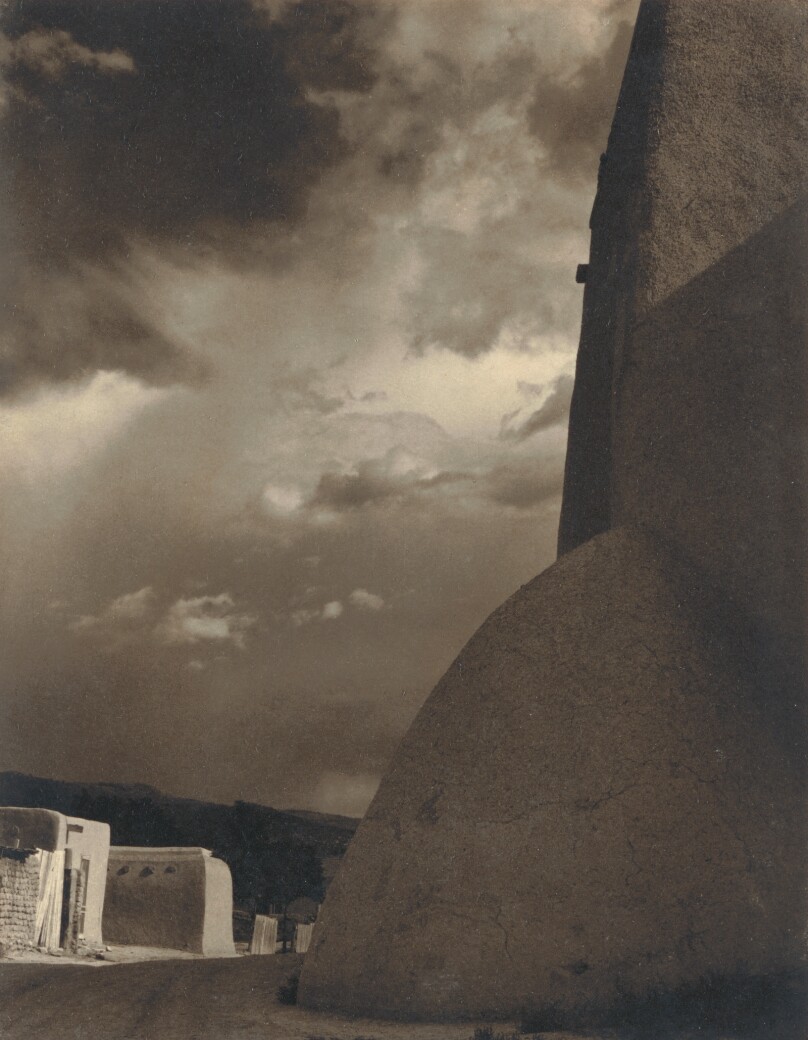
Buttress, Ranchos de Taos, New Mexico
Creator
Paul StrandAmerican Photographer · 1890–1976
All works by this person →Paul Strand began photographing in New York in the 1910s. During the early 1920s he received recognition for both his painting and his photography. He visited New Mexico in 1926 and, beginning in 1930, returned for three consecutive summers, making portraits of artist friends and acquaintances. It was there, amidst a community of visual artists and writers, that Strand began to develop his belief
More on Getty ULAN- Date
- 1932
- Medium
- Platinum print
- Culture
- American
- Department
- Photographs
- Institution
- Getty Museum
- Object ID
- 65b38489-94d8-44ac-b88f-cd1ef8037308
From the Getty Museum record
In the 1930s, many artists headed to Taos, New Mexico, at the invitation of Mabel Dodge Luhan (1879-1962), the great patron of the arts who resided in the Southwest. Paul Strand first met her in 1926 and visited the region from 1930 to 1932. Like many of the artists gathered there, Strand was inspired by the vast landscape, which was so different from that of the eastern seaboard. In this image of the church of San Francisco de Assisi in Rancho de Taos, the building’s monumental forms in the foreground stand against a brewing sky. The smallness of the print and the largeness of the subject are at odds with each other. By using the smaller size, where the architectural structure fills one third of the frame, Strand succeeds in magnifying the subject. In a sense it demands more attention from the viewer, who is forced to consider and ultimately reconcile the relationships between size and volume, much in the same way that the artist considered these elements when composing the picture. Viewed independently, and collectively, the New Mexico images reflect a major development in Strand's overall approach to photography, in that his previous methods coalesced into one distinct aesthetic ([86.XM.683.63](https://www.getty.edu/art/collection/object/104E71), [86.XM.683.81](https://www.getty.edu/art/collection/object/106NT0), [86.XM.683.82.1](https://www.getty.edu/art/collection/object/1096XB), [86.XM.686.1](https://www.getty.edu/art/collection/object/104E78), and [88.XM.19](https://www.getty.edu/art/collection/object/106F5Q)). Applying the same principles he initially explored in his abstract still lifes from around 1916 (link to 86.XM.683.59), Strand created compositions that explored the formal elements of the subject by using shape, mass, texture, and light as defining properties. In his repetitive photographing of the landscape and architecture, he essentially created a sense of the place, almost like his detailed nature studies from the 1920s ([86.XM.683.97.1](https://www.getty.edu/art/collection/object/1096TS), [86.XM.XM.683.104](https://www.getty.edu/art/collection/object/106NTF), [85.XM.200](https://www.getty.edu/art/collection/object/106F4K)), only now his vision had expanded partly in response to the vastness of the subject. Adapted from _Paul Strand_, In Focus: Photographs from the J. Paul Getty Museum by Anne M. Lyden (Los Angeles: J. Paul Getty Museum, 2005), 42, 46. ©2005, J. Paul Getty Trust.
The authoritative record is held by Getty Museum. LinkedCulture surfaces this object and its connections; it does not alter institutional metadata.
Get printable QR codesHide QR codes
Open QR codes for this object page and the museum record. They stay collapsed until needed.
Related across collections
Semantically similar works from Getty Museum and other institutions.