Getty Museum
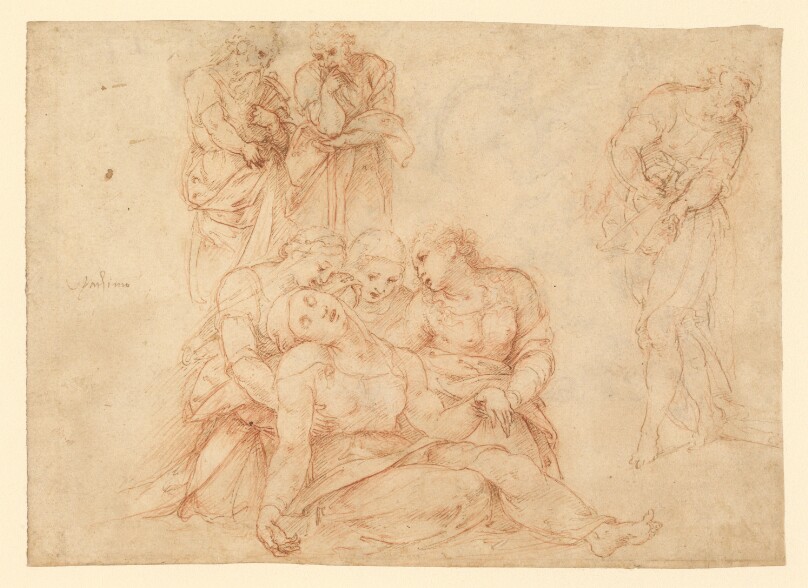
The Swooning Virgin Supported by Three Holy Women and Three Studies of Men (recto); Saint George and the Dragon (verso)
Creator
Cesare da SestoItalian Artist · 1477–1523
All works by this person →Scholars are uncertain about the chronology of Cesare da Sesto's life. What is clear is his style: a characteristic, lifelong synthesis of Leonardo da Vinci and Raphael's art. Equally apparent is this itinerant painter's importance: he spread the new artistic ideas of the High Renaissance, transmitting elements of Raphael's style to northern Italy and aspects of Leonardo to Italy's southern region
More on Getty ULAN- Date
- about 1510
- Medium
- Pen and brown ink over red chalk
- Culture
- Italian
- Department
- Drawings
- Institution
- Getty Museum
- Object ID
- 665c6655-48f5-4a96-ade2-bf013712a67e
From the Getty Museum record
Cesare da Sesto's sensitive line and refined shading create a delicate, elegant effect in which his figures seem to be laid ever so gently onto the page. He made his initial sketch in red chalk, going over the final design in pen and ink, adding contours and shading. Known for his lifelong synthesis of Raphael's and Leonardo da Vinci's art, Cesare followed their examples here. The lively gestures and poses of the male figures-especially the one at right-reflect Leonardo's influence, while the *Saint George and the Dragon* on the verso resembles Raphael's painting of the subject now in the National Gallery of Art in Washington. This sheet once may have been part of a sketchbook, now-dismembered in the Pierpont Morgan Library. The Morgan sketchbook pages are the same size as this sheet, and they show similar figures and groups inspired by Leonardo and Raphael, drawn with the same graceful style.
The authoritative record is held by Getty Museum. LinkedCulture surfaces this object and its connections; it does not alter institutional metadata.
Get printable QR codesHide QR codes
Open QR codes for this object page and the museum record. They stay collapsed until needed.
Related across collections
Semantically similar works from Getty Museum and other institutions.