Getty Museum
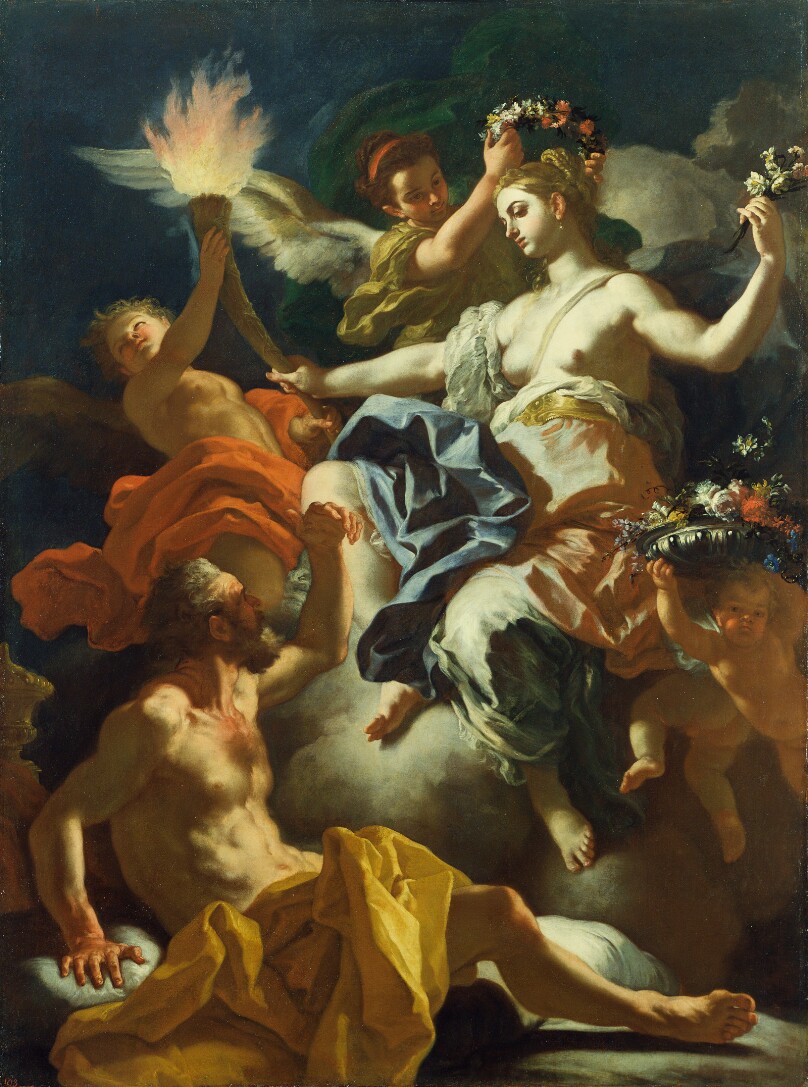
Aurora Taking Leave of Tithonus
Creator
Francesco SolimenaItalian Artist · 1657–1747
All works by this person →Francesco Solimena settled in Naples in 1674 and became the unchallenged head of the Neapolitan school of painting during the first half of the 1700s. He modeled his painting on the exuberant Baroque style of his predecessor, Luca Giordano, modified by the classical tendencies of Roman decorator Pietro da Cortona. The brownish shadows that are such an identifiable element of Solimena's style are i
More on Getty ULAN- Date
- 1704
- Medium
- Oil on canvas
- Culture
- Italian
- Department
- Paintings
- Institution
- Getty Museum
- Object ID
- 75bf6827-db53-46dd-b60a-c681841f59f8
From the Getty Museum record
In Greek legend, Eos, or Aurora, the goddess of dawn, falls in love with the mortal Tithonus, son of King Laomedon of Troy. According to the Homeric *Hymn to Aphrodite*, Aurora prevailed on Jupiter to grant the young human immortality, though later realized that she failed to stipulate his eternal youth in this request. To her horror, as their love affair continues, the once beautiful Tithonus begins to show signs of age. Solimena illustrates a moment later in the narrative, where, preparing to leave for earth to bring about the dawn, Aurora sits on a cloud while an angel crowns her with a wreath of flowers. She looms dominantly over her aged lover, who shields his eyes from the goddess’s brightness. The goddess, pained by Tithonus’ withering appearance and failing body, eventually decided to put him out of his misery and turned him into a grasshopper, to be reminded of him whenever she heard the insect’s song. This large canvas, as well as the *[Death of Messalina](http://www.getty.edu/art/collection/objects/627/)* and *[Venus at the Forge of Vulcan](http://www.getty.edu/art/collection/objects/736/)*, also in the Getty Museum’s collection, were probably parts of a larger ensemble made for the Procurator, or state attorney, of Venice, Gerolamo Canale. The series may commemorate a marriage, since the pictures of *Venus* and *Aurora* both illustrate exchanges between goddesses and their lovers, while the *Death of Messalina* warns of the dangers of infidelity.
The authoritative record is held by Getty Museum. LinkedCulture surfaces this object and its connections; it does not alter institutional metadata.
Get printable QR codesHide QR codes
Open QR codes for this object page and the museum record. They stay collapsed until needed.
Related across collections
Semantically similar works from Getty Museum and other institutions.