Getty Museum
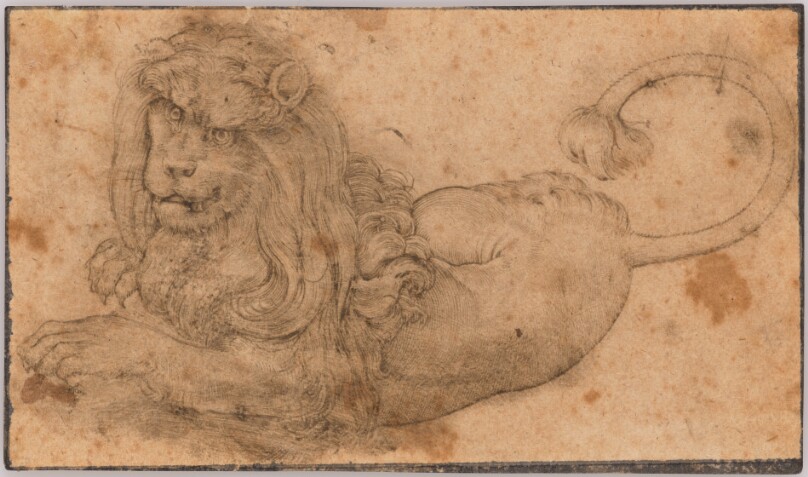
Study of a Lion
Creator
Lucas Cranach the ElderGerman Artist · 1472–1553
All works by this person →Lucas Cranach the Elder took his surname from his birthplace, Kronach, where he probably trained with his painter father. Around 1501 he went to Vienna, where he focused on drawing ruins and windswept trees. In 1505 he became court painter to Frederick the Wise of Saxony in Wittenberg, a position he maintained for life under various electors. At court, Cranach specialized in portraits. Bold design
More on Getty ULAN- Date
- 1509
- Medium
- Pen and brown ink
- Culture
- German
- Department
- Drawings
- Institution
- Getty Museum
- Object ID
- 762b6efb-afe1-4889-8ff7-30f65694ffba
From the Getty Museum record
Lucas Cranach the Elder drew this lion with a quill pen cut to an extremely fine point. Using numerous delicate lines, he built up the long flowing mane, the smooth coat, and the tufted tail. This drawing provided the inspiration for the lion in a later woodcut, although Cranach changed the coat and mane to make them more shaggy and curly. Exotic animals such as lions, tigers, and elephants were extremely rare in Europe in the 1500s. Although members of the aristocracy kept some in private zoos or menageries, artists mainly had to rely on prints or stuffed examples if they wished to include an exotic beast in their works. It is thus unlikely that Cranach drew this lion from life, despite its lively, lopsided expression.
The authoritative record is held by Getty Museum. LinkedCulture surfaces this object and its connections; it does not alter institutional metadata.
Get printable QR codesHide QR codes
Open QR codes for this object page and the museum record. They stay collapsed until needed.
Related across collections
Semantically similar works from Getty Museum and other institutions.