Getty Museum
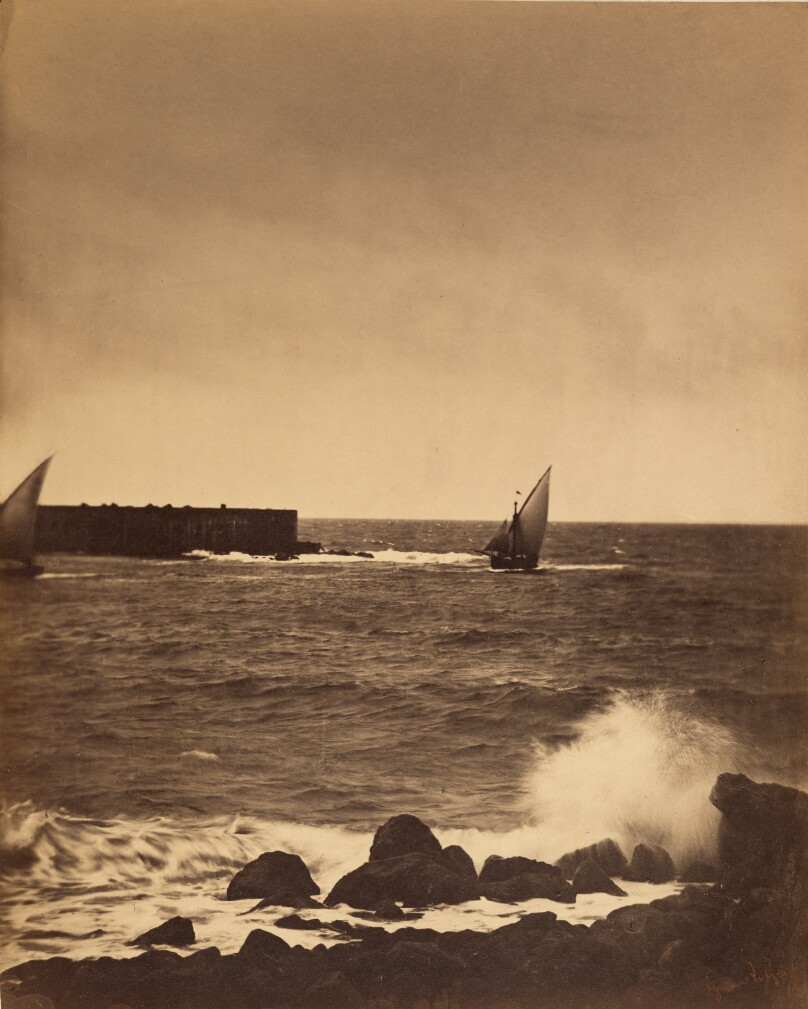
The Breaking Wave
Creator
Gustave Le GrayFrench Photographer · 1820–1884
All works by this person →Though he was trained as a painter, Gustave Le Gray made his mark in the emerging medium of photography. An experimenter and technical innovator, Le Gray pioneered the use of the paper negative in France and developed a waxed-paper negative that produced sharper-focus prints. In 1851 he began to use collodion on glass negatives, which further increased the clarity of his images. He became one of t
More on Getty ULAN- Date
- 1857
- Medium
- Albumen silver print from glass negatives
- Culture
- French
- Department
- Photographs
- Institution
- Getty Museum
- Object ID
- 770535b8-a201-4d26-843e-0aa36f9e38f8
From the Getty Museum record
> Around 1855 Gustave Le Gray began to make a series of seascapes and maritime studies that proved to be very popular and financially profitable. Interestingly, he first exhibited them in December 1856 at the Photographic Society in London. This speaks to the transnational fascination in photography that existed shortly after the invention of the medium. This view was made at Sète, a Mediterranean port in southern France (southwest of Montpellier). It was taken from roughly the same position on the bank as *Le Grande Vague, Sète* (*The Great Wave, Sète*) ([84.XM.637.1](http://www.getty.edu/art/collection/objects/62015)). This print's vertical format, the only one among Le Gray's many seascapes, emphasizes the boats' blowing sails. > > Capturing motion, such as a bobbing boat or waves breaking on the rocks, was still a great challenge to photographers, but Le Gray was an indomitable innovator whose technical improvements to the medium shortened his exposure times. Balancing the different light intensities of the sea and sky in one simultaneous exposure was not easily solved. If he exposed the negative so that the sea was rendered clearly, the sky would be so overexposed as to appear empty. If he exposed for the sky, the sea and shore would appear only as silhouettes. Le Gray surmounted this dilemma for this composition and others by montaging several paper or glass plate negatives with different exposures. He expertly matched up the negatives so that it is very difficult to detect the "seams." In this particular image, the tones of the sea and land take precedence over a more muted sky. Adapted from getty.edu, Interpretive Content Department, 2008. For more information about the author and this piece, see: Aubanas, Sylvie. *Gustave Le Gray, 1820-1884.* Los Angeles: The J. Paul Getty Museum, 2002. Parry Janis, Eugenia. *The Photography of Gustave Le Gray*. Chicago: The Art Institute of Chicago and The University of Chicago, 1987.
The authoritative record is held by Getty Museum. LinkedCulture surfaces this object and its connections; it does not alter institutional metadata.
Get printable QR codesHide QR codes
Open QR codes for this object page and the museum record. They stay collapsed until needed.
Related across collections
Semantically similar works from Getty Museum and other institutions.