Getty Museum
Bowl
Creator
Ignaz PreisslerGerman Artist · 1676–1741
All works by this person →In the early 1700s, kings, archbishops, and counts all coveted the porcelain and glass vessels painted by Ignaz Preissler. One Polish count employed him for over seven years to decorate more than two hundred pieces of porcelain and twelve glass objects, including covered tankards, goblets, bottles, bowls, and tumblers. Unlike many porcelain painters, Preissler was not affiliated with any factory b
More on Getty ULAN- Date
- porcelain about 1700; painted decoration about 1715–1720
- Medium
- Hard-paste porcelain, underglaze blue, black enamel decoration, and gilding
- Culture
- Chinese (Kangxi)
- Department
- Decorative Arts
- Institution
- Getty Museum
- Object ID
- 7806c2ec-77ef-46b6-80d9-0d969d15b9bc
From the Getty Museum record
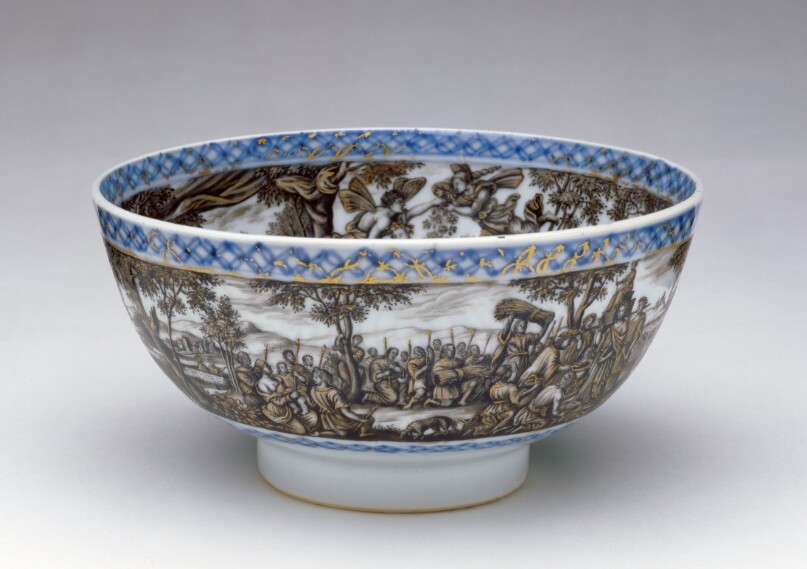
In the 1720s the town of Breslau in present-day Poland became a center of activity for free-lance artists who decorated glass and ceramic wares in their own studios, independent of factory supervision. Ignaz Preissler, who painted the intricate scenes on this bowl, was one of the most accomplished of these *Hausmaler* (home painters). Using a plain porcelain bowl imported from China and decorated only with a diaper-patterned rim in underglaze blue, Preissler painted on an allegorical scene in lead black. He copied engravings after a ceiling painting by Pierre Mignard depicting the four seasons in the château of Saint-Cloud. The bowl's interior scene, which shows the marriage of Flora and Zephyr, represents Spring, and the sacrifice of Ceres on the outside represents Summer. The plate on which the bowl once stood, which illustrates Autumn and Winter, is now in the Musée Nationale de Ceramique in France.
The authoritative record is held by Getty Museum. LinkedCulture surfaces this object and its connections; it does not alter institutional metadata.
Get printable QR codesHide QR codes
Open QR codes for this object page and the museum record. They stay collapsed until needed.
Related across collections
Semantically similar works from Getty Museum and other institutions.