Getty Museum
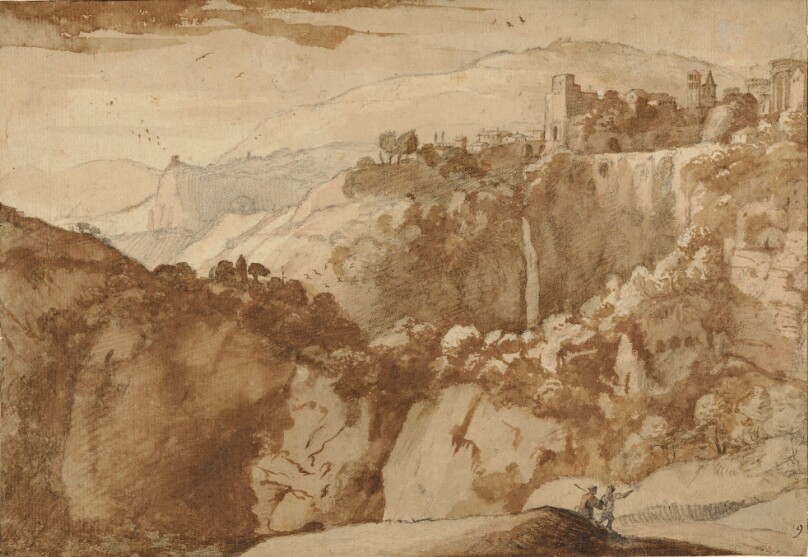
View of Tivoli (recto); View of Tivoli (verso)
Creator
Claude Lorrain (Claude Gellée)French Artist · 1604–1682
All works by this person →> Claude Lorrain knew the real world by heart, down to its minute details. He used it as a means of expressing the harmonious universe of his soul. > > --Johann Wolfgang von Goethe A peasant's son, Claude Gellée became known as Claude Lorrain, named after the duchy in which he was born. He had difficulty writing French and Italian and could barely count, but he could explain light's effects like a
More on Getty ULAN- Date
- about 1640
- Medium
- Black chalk with brown and reddish-brown wash (recto); Pen and ink (verso)
- Culture
- French
- Department
- Drawings
- Institution
- Getty Museum
- Object ID
- 78f7cace-bc7f-437b-909e-83d9ad6bcb26
From the Getty Museum record
Claude Lorrain bathed this view of Tivoli in shimmering, translucent washes whose tonal range represents a continuum of light and shadow that both defines and dematerializes form. Characteristically, he silhouetted forms against expanses of golden Italian light. The pen-and-ink study on the verso may have been made first as a compositional outline for the drawing on the recto. More than thirty views of Tivoli, one of Claude's favorite subjects, survive. As always, he focused on the landscape rather than village architecture. He drew this study from nature, rather than composing it in the studio, and he may have used it in preparing a painting. According to a German painter colleague, Joachim von Sandrart, Tivoli played a role in Claude's decision to paint *en plein air* (outdoors) rather than only in the studio: "[I]n Tivoli, in the wild rocks at the famous cascade . . . he found me painting from life and saw that I painted many works from nature itself, making nothing from imagination; this pleased himself so much that he applied himself eagerly to adopting the same method."
The authoritative record is held by Getty Museum. LinkedCulture surfaces this object and its connections; it does not alter institutional metadata.
Get printable QR codesHide QR codes
Open QR codes for this object page and the museum record. They stay collapsed until needed.
Related across collections
Semantically similar works from Getty Museum and other institutions.