Getty Museum
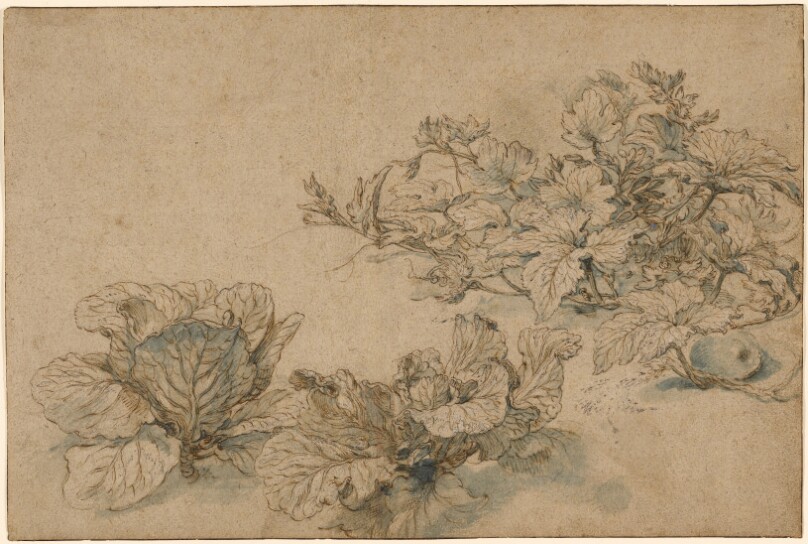
Studies of a Marrow Plant and Cabbages
Creator
Abraham BloemaertDutch Artist · 1564–1651
All works by this person →Despite being the son of an architect and sculptor, Abraham Bloemaert's artistic training was fragmented. He worked under six masters, for one of whom he was also a houseboy. He absorbed the Mannerism of the School of Fontainebleau, which stayed with him for life. Except for a short period in Amsterdam, he lived in Utrecht, becoming so important that Peter Paul Rubens visited him in 1627. Around 1
More on Getty ULAN- Date
- about 1605–1614
- Medium
- Pen and brown ink, blue wash, and white gouache heightening
- Culture
- Dutch
- Department
- Drawings
- Institution
- Getty Museum
- Object ID
- 7ab67d33-0df4-4072-9b1e-edb225b35738
From the Getty Museum record
Two cabbage plants, one quite tightly closed while the leaves of the other begin to unfurl, fill one side of a sheet. In the upper right, the tendrils of a squash or gourd plant reach out towards the center, with a fruit lying beneath the shade of its leaves. Abraham Bloemaert effectively contrasted such details as the broad leaves of the cabbage, with its coarse pattern of veins, with the delicate squash tendrils. Carefully applied areas of blue wash indicate shadows but also trail off into an atmospheric suggestion of continuity with the surrounding terrain. One of Bloemaert's contemporaries noted that "he has a clever way of drawing with a pen, and by adding small amounts of watercolor, he produced unusual effects *.* " The spiraling forms of naturalistic motifs captivated Bloemaert and other Dutch artists in the 1600s. He frequently enlivened the foreground of his paintings and designs for prints with detailed illusionistically drawn plants. Being especially attracted to the pairing of cabbages and gourds, Bloemaert probably made this drawing as a study for such motifs in paintings or prints.
The authoritative record is held by Getty Museum. LinkedCulture surfaces this object and its connections; it does not alter institutional metadata.
Get printable QR codesHide QR codes
Open QR codes for this object page and the museum record. They stay collapsed until needed.
Related across collections
Semantically similar works from Getty Museum and other institutions.