Getty Museum
Flower Still Life
Creator
Ambrosius Bosschaert the ElderDutch Artist · 1573–1621
All works by this person →During the 1600s the Dutch became Europe's leading horticulturists, and exotic flowers became a national obsession. Not surprisingly, flower painters were among the best-paid artists. In 1621, Ambrosius Bosschaert commanded a thousand guilders for a single flower picture. Nonetheless, his output was relatively small, for he was also an art dealer, handling works by artists like Paolo Veronese. Ant
More on Getty ULAN- Date
- 1614
- Medium
- Oil on copper
- Culture
- Dutch
- Department
- Paintings
- Institution
- Getty Museum
- Object ID
- 7b11164e-ea13-4d46-8cf9-40c189aabd0a
From the Getty Museum record
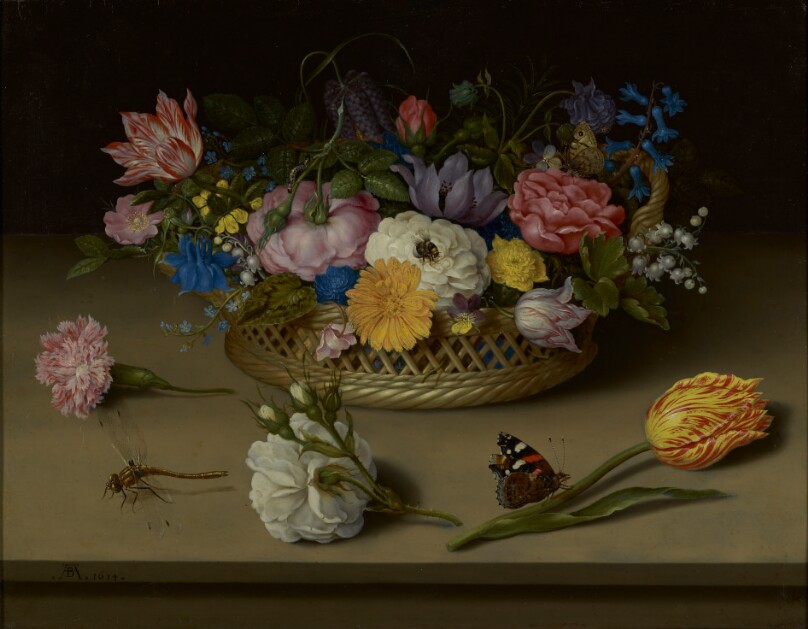
A pink carnation, a white rose, and a yellow tulip with red stripes lie in front of a basket of brilliantly colored flowers. Various types of flowers that would not bloom in the same season appear together here: roses, forget-me-nots, lilies-of-the-valley, a cyclamen, a violet, a hyacinth, and tulips. Rendering meticulous detail, Ambrosius Bosschaert the Elder conveyed the silky texture of the petals, the prickliness of the rose thorns, and the fragility of opening buds. Insects crawl, alight, or perch on the bouquet. Each is carefully described and observed, from the dragonfly's transparent wings to the butterfly's minutely painted antennae. Although a vague reference, insects, short-lived like flowers, are a reminder of the brevity of life and the transience of its beauty. A rising interest in botany and a passion for flowers led to an increase in painted floral still lifes at the end of the 1500s in both the Netherlands and Germany. Bosschaert was the first great Dutch specialist in fruit and flower painting and the head of a family of artists. He established a tradition that influenced an entire generation of fruit and flower painters in the Netherlands.
The authoritative record is held by Getty Museum. LinkedCulture surfaces this object and its connections; it does not alter institutional metadata.
Get printable QR codesHide QR codes
Open QR codes for this object page and the museum record. They stay collapsed until needed.
Related across collections
Semantically similar works from Getty Museum and other institutions.