Getty Museum
The Abduction of the Sabines
Creator
Girolamo del PacchiaItalian Artist · 1477–1533
All works by this person →Even though Giorgio Vasari mentioned Girolamo del Pacchia in his *Lives of the Artists,* scholars have only recently begun to separate Pacchia's work from that of his teacher Giacomo Pacchiarotti. Pacchia actually took Pacchiarotti's name, which has contributed to the confusion. Pacchia was the son of a metalsmith who specialized in weapons. By 1502 he and Pacchiarotti were Pinturicchio's assistan
More on Getty ULAN- Date
- about 1520
- Medium
- Oil on panel
- Culture
- Italian
- Department
- Paintings
- Institution
- Getty Museum
- Object ID
- 7b78d7df-3b7f-4db9-93dc-5fa8addb8863
From the Getty Museum record
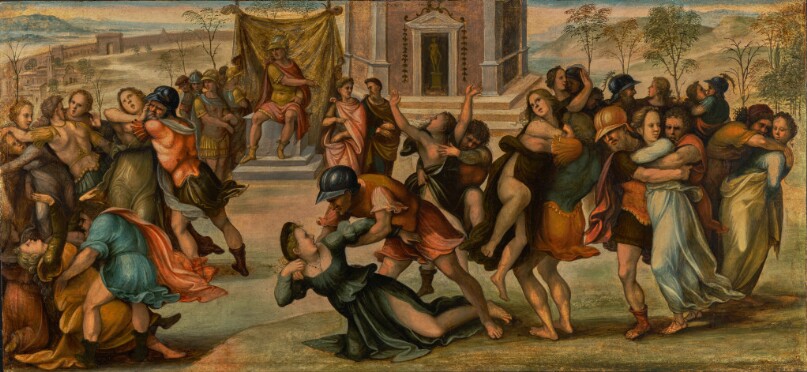
In book one of his *History of Rome*, Livy (59 or 64 BC – 12 or 17 AD) recounts that the city was built by soldiers and a rabble of men seeking asylum in exchange for their work as laborers in its construction. Shortly after Rome was established, its founder, Romulus, sought to bring equilibrium to the city’s population, recognizing that his new settlement was “threatened to last for only one generation, since through the absence of women there was no hope of offspring, and there was no right of intermarriage with their neighbors.” He sent envoys to many of the surrounding communities, entreating them to grant the Romans this right of intermarriage. When these local tribes refused, Romulus “disguised his resentment” and invited his nearest neighbors, including the Sabines, to his new city for a festival. The celebrations were a ruse, and the Romans drove away the Sabine men and abducted their women. The Sabine men bided their time in carefully preparing their counter attack, during which time the Romans successfully persuaded the women to join their cause, offering them legal marriage and all the privileges of free citizens of Rome, which eventually led to “reconciliation and love.” When the Sabine tribe returned to wage bloody war on the Romans, Livy reports that the women threw themselves between the warring armies and their impassioned speeches led to a truce. *The Abduction of the Sabines* was a popular subject in Girolamo del Pacchia’s time as a defining episode in the legendary history of Rome. The story of the foundation of the city was of specific importance to Sienese patrons who understood themselves to be descendants of the ancient Romans, since Siena was said to have been established by Aschius and Senius, the nephews of Romulus. The subject also afforded the artist an opportunity to display his virtuosity by depicting a mass of figures, some nude, engaged in dramatic struggle. Because of its long, horizontal format, the painting was thought at one time to have been part of a *cassone* (a decorated chest used for storage in domestic settings, and traditionally gifted as part of a bride’s dowry), but its relatively large size suggests that it is more likely to have functioned as a *spalliera*, or decorative wall panel. *Spalliere* would often have been placed directly above *cassoni* or other items of furniture, or at head or shoulder height. The downward gaze of several figures in the crowd would have been complemented by a viewing position from below, and the downward motion of the Sabine woman in the foreground would have given the impression that she is falling toward the viewer.
The authoritative record is held by Getty Museum. LinkedCulture surfaces this object and its connections; it does not alter institutional metadata.
Get printable QR codesHide QR codes
Open QR codes for this object page and the museum record. They stay collapsed until needed.
Related across collections
Semantically similar works from Getty Museum and other institutions.