Getty Museum
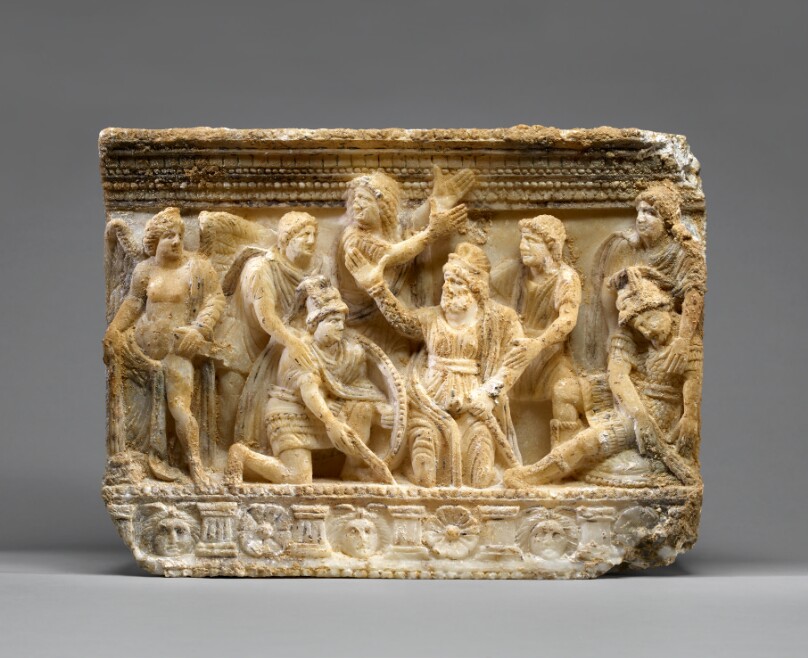
Cinerary Urn with Eteokles and Polyneikes
Creator
UnknownAll works by this person →More on Getty ULAN- Date
- 200–100 B.C.
- Medium
- Alabaster with polychromy
- Culture
- Etruscan
- Department
- Sculpture
- Institution
- Getty Museum
- Object ID
- 7d4cec7a-0623-497f-b689-c064693a78f9
From the Getty Museum record
Made in Volterra, this urn depicts the sons of Oedipus, Eteokles and Polyneikes, who fought for the throne of Thebes. Observing the battle is a winged infernal demon at left, Vanth, who holds a downturned torch and a book scroll, symbols that portend the brothers’ destiny in the Underworld. Before her, a companion bends forward to steady one of the dying brothers, who crouches on bent knee behind his shield. Both figures look toward the older bearded man at the center, who falls his knees in lament, dramatically extending his right hand. The knotty staff in his left hand identifies him as Oedipus, king of Thebes, dressed in a Phrygian cap and long-sleeved belted tunic and trousers. In the background above the two kneeling protagonists is a woman in a chiton and mantle (Jocasta or Antigone), waving her hands in distress. A fourth man attentively holds the king’s left elbow. Behind him, a second warrior is mortally wounded and collapses onto an inverted shield, with his head bowed and a sword held listlessly across his lap. At the right side, a man in a chlamys supports the dead fighter. The battle relief is framed above by a cornice of dentils, bands of beading, and leaves, and below is a Doric triglyph frieze with alternating gorgon masks and rosettes. There are traces of Egyptian Blue and cinnabar on the frieze and areas of the drapery. Hundreds of stone and terracotta cinerary urns carved in the workshops of Volterra, Perugia, and Chiusi depict this iconic battle scene from the myth of the Seven Against Thebes. The presence of King Oedipus, however, is infrequent. His dramatic gesture evokes the climactic episode of his sons’ mutual fratricide, which was staged in Euripides’ *Phoenissae* (The Phoenician Women), written about 408 B.C. Theatrically gesticulating figures suggest that Etruscan viewers may have been familiar with the Euripidean tragedy, though whether through art or staged performances is a matter of some debate.
The authoritative record is held by Getty Museum. LinkedCulture surfaces this object and its connections; it does not alter institutional metadata.
Get printable QR codesHide QR codes
Open QR codes for this object page and the museum record. They stay collapsed until needed.
Related across collections
Semantically similar works from Getty Museum and other institutions.