Getty Museum
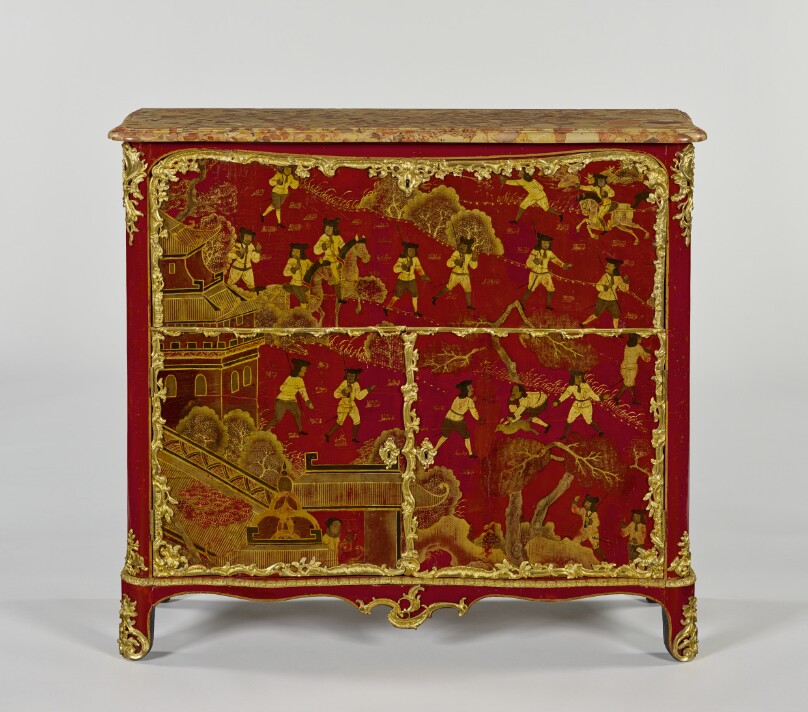
Secrétaire
Creator
Jacques DuboisFrench Artist · 1694–1763
All works by this person →Jacques Dubois, a descendant of a family of French *ébénistes,* probably learned the craft in the workshop of his half-brother, Nöel Gérard, an important cabinetmaker and dealer of the 1720s and 1730s. Dubois did not become a master until relatively late in his career, at the age of forty-eight. The inventory made after his death reveals a large workshop with a varied range of production including
More on Getty ULAN- Date
- about 1755
- Medium
- White oak and sycamore maple veneered with panels of red Chinese lacquer on Japanese arborvitae and painted with European lacquer; interior drawers of sycamore maple and Japanese arborvitae; gilt-bronze mounts; brass and iron hardware and locks; brèche d'Alep top; replacement silk velvet and trim
- Culture
- French
- Department
- Decorative Arts
- Institution
- Getty Museum
- Object ID
- 7e415529-5231-4a40-82e0-31cededea336
From the Getty Museum record
The fall front on the upper section of this secrétaire lowers on hinges to reveal a central open pigeon hole flanked by drawers, with a large open compartment above. The interior behind the large double doors below is divided in half by a shelf with the lower half further divided into two by a vertical partition. The front and sides of the secrétaire are each veneered with a single panel of red Asian lacquer, the panel on the front having been cut into three pieces to form the fall front and the doors. The remaining exterior surfaces and the entire interior are decorated with red European lacquer. Traditionally Parisian secretaries produced during the 1700s are of greater height than width, but this piece is an exception. It was evidently custom made to fit the large panel of Asian lacquer forming the front. This panel shows Europeans – depicted wearing distinctive jackets, breeches, and hats – hunting deer in front of a large building with Asian architectural features. The figures are probably meant to represent members of the Dutch East India Company, the primary European merchants operating in eastern Asia during the 1600s, and the panel may have been made especially for export to Europe.
The authoritative record is held by Getty Museum. LinkedCulture surfaces this object and its connections; it does not alter institutional metadata.
Get printable QR codesHide QR codes
Open QR codes for this object page and the museum record. They stay collapsed until needed.
Related across collections
Semantically similar works from Getty Museum and other institutions.