Getty Museum
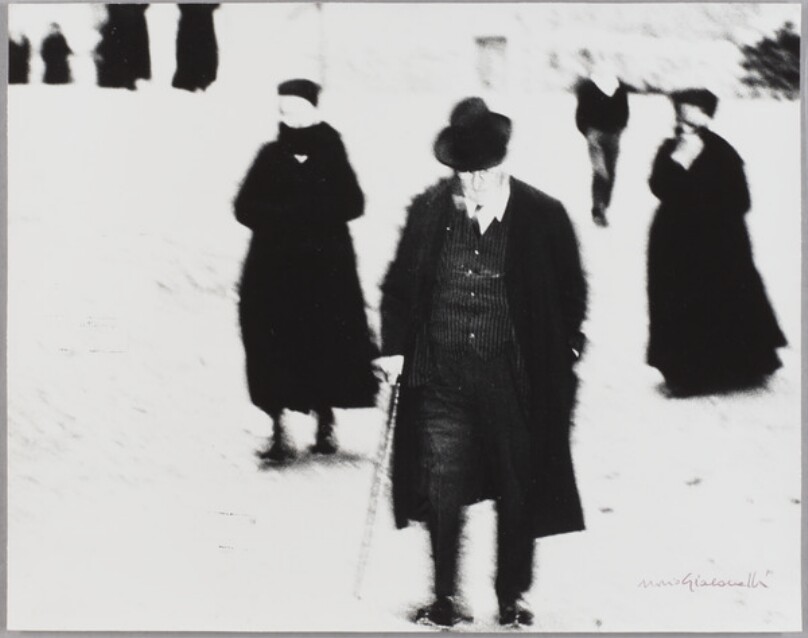
Scanno
Creator
Mario GiacomelliItalian Photographer · 1925–2000
All works by this person →Mario Giacomelli (1925–2000) is widely recognized as one of the foremost Italian photographers of the twentieth century. Born into poverty, he lived his entire life in Senigallia, a town on the Adriatic coast, in the Marche region. After losing his father at age nine and completing elementary school at eleven, he apprenticed as a typesetter and printer, while also teaching himself to paint and wri
More on Getty ULAN- Date
- negative 1957–1959; print 1980s
- Medium
- Gelatin silver print
- Culture
- Italian
- Department
- Photographs
- Institution
- Getty Museum
- Object ID
- 8001fc6b-e206-4e0f-a33b-cf6324b36674
From the Getty Museum record
Following his sustained observation of hospice residents in Senigallia ([2016.179.6.10](http://www.getty.edu/art/collection/objects/297444/), [2016.179.6.11](http://www.getty.edu/art/collection/objects/297445/), [2016.179.6.12](http://www.getty.edu/art/collection/objects/297446/), [2016.179.40](http://www.getty.edu/art/collection/objects/297490/), [2020.74](http://www.getty.edu/art/collection/objects/350481/)), the photographs that Giacomelli made during trips to Scanno in 1957 and 1959 further demonstrate his ability to describe people in a specific time and place. In this town located in the Apennine Mountains of central Italy, about 270 miles south of Senigallia, Giacomelli encountered men and women going about their daily chores or gathering in the square, draped in dark garments or cloaks, their heads covered with hats or scarves. Even when congregating, subjects seem to be isolated or lost in thought. Whether in sharp focus or blurred by movement, the occasional individual who looks directly into his camera suggests a sense of mystery or furtiveness. Giacomelli used a slow shutter speed and shallow depth of field to photograph these stark, black-clad figures against whitewashed architectural settings, introducing indistinct passages that amplify the fairy-tale mood of a town that appears to be irretrievably steeped in the past. See other examples of works from this series ([2016.179.7](http://www.getty.edu/art/collection/objects/297453/), [2016.179.5.12](http://www.getty.edu/art/collection/objects/297427/), [2016.179.6.9](http://www.getty.edu/art/collection/objects/297443/), [2016.179.6.14](http://www.getty.edu/art/collection/objects/297448/), [2016.179.6.17](http://www.getty.edu/art/collection/objects/297451), [2016.179.26](http://www.getty.edu/art/collection/objects/297475/), [2016.179.30](http://www.getty.edu/art/collection/objects/297479/), [2016.179.35](http://www.getty.edu/art/collection/objects/297484/), [2016.179.39](http://www.getty.edu/art/collection/objects/297489/), [2016.179.41](http://www.getty.edu/art/collection/objects/297492/), [2016.179.44](http://www.getty.edu/art/collection/objects/297498/), [2016.179.61](http://www.getty.edu/art/collection/objects/297520/)).Virginia Heckert, J. Paul Getty Museum, Department of Photographs 2021
The authoritative record is held by Getty Museum. LinkedCulture surfaces this object and its connections; it does not alter institutional metadata.
Get printable QR codesHide QR codes
Open QR codes for this object page and the museum record. They stay collapsed until needed.
Related across collections
Semantically similar works from Getty Museum and other institutions.