Getty Museum
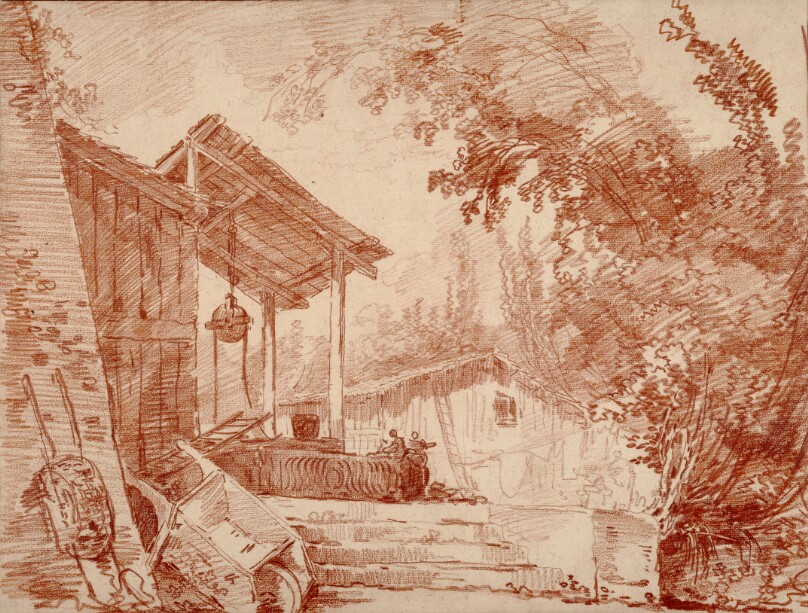
Farmyard with Two Figures by a Well and a Large Wheelbarrow in the Foreground
Object Description · Getty Museum
Getty Museum’s catalogue record
- produced_by.carried_out_by[0].id
- https://data.getty.edu/museum/collection/person/7998f749-2f08-4980-9ddf-c08d9450fa77
- Artist/Maker
- Hubert Robert
- subject_of[Homepage].id
- https://www.getty.edu/art/collection/object/107TMS
- Date
- 1760–1765
- Medium
- Red chalk, on buff-colored paper
- Culture
- French
- Object Type
- Drawing
Taken from LinkedCulture’s stored copy of Getty Museum’s record. A fresh capture of the museum’s own record has not been made for this object yet.
The authoritative record is held by Getty Museum. LinkedCulture surfaces this object and its connections; it does not alter institutional metadata. The fields above are the museum’s, under its own labels. LinkedCulture’s derived fields are listed separately below and marked as ours.
Get printable QR codesHide QR codes
Open QR codes for this object page and the museum record. They stay collapsed until needed.
How LinkedCulture maps this record
To search objects from different museums together, LinkedCulture reads each museum’s record into a common set of fields. The values below are LinkedCulture’s, under LinkedCulture’s names. They are not Getty Museum’s wording; the museum’s own record is shown above under its own labels.
- Object ID
- 8099b3e4-76de-45dd-be06-ffe5f2fe2d6e
- Object Type
- Drawing
- Getty Museum field “Object Type” · copied as is
- Creator
- Hubert Robert
- Getty Museum field “Artist/Maker” · copied as is
- Culture
- French
- Getty Museum field “Culture” · copied as is
- Medium
- Red chalk, on buff-colored paper
- Getty Museum field “Medium” · copied as is
- Department
- Drawings
- Getty Museum field “Department” · derived by LinkedCulture from the museum field · Getty's classification category is stored as department.
- Credit Line
- The J. Paul Getty Museum, Los Angeles
- Getty Museum field “Standard Credit Line” · the first available of several museum fields
- Getty Museum field “Source Credit Line” · the first available of several museum fields
- Date
- 1760–1765
- Getty Museum field “Date” · copied as is
- Begin Year
- 1760
- Getty Museum field “produced_by.timespan.begin_of_the_begin” · derived by LinkedCulture from the museum field
- End Year
- 1765
- Getty Museum field “produced_by.timespan.end_of_the_end” · derived by LinkedCulture from the museum field
The museum’s own record has not been captured for this object yet, so the museum fields shown above are limited to values LinkedCulture stored unchanged.
Related across collections
Semantically similar works from Getty Museum and other institutions.