Getty Museum
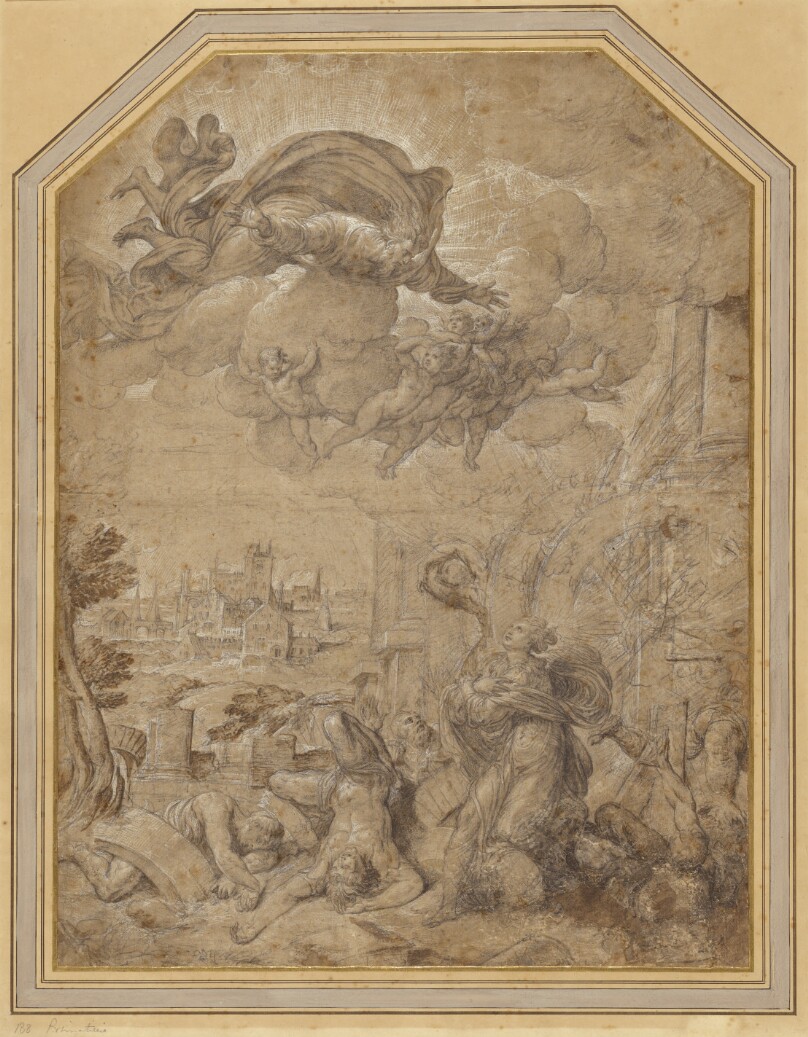
Saint Catherine of Alexandria at the Wheel
Creator
Nicolò dell'AbateItalian Artist · 1509–1512
All works by this person →Nicolò dell'Abate probably first trained with his father, a stuccoist. After serving as a soldier, he assisted a local painter in Modena in 1537, helping to decorate a slaughterhouse facade. Nicolò earned his first major success in 1546, with twelve frescoes of the *Aeneid* for a castle near Modena. In the next year, he moved to Bologna, where his projects included decorating four rooms in a palac
More on Getty ULAN- Date
- 1547–1550
- Medium
- Black chalk and brush and brown ink, heightened with white opaque watercolor, on brown paper
- Culture
- Italian
- Department
- Drawings
- Institution
- Getty Museum
- Object ID
- 81c9c3af-7995-4f7a-bd94-dd6bc7f654e6
From the Getty Museum record
The legendary Saint Catherine of Alexandria gracefully thanks God the Father and his angels for rescuing her from torture on a spiked wheel. The soldiers of the emperor Maxentius had attempted to break this faithful Christian on the wheel because of her public protest against the worship of idols, but the wheel fell to pieces and she was unhurt. Flying splinters were said to have killed some spectators. In this large drawing, Nicolò dell'Abate integrated two complex sets of figures against a characteristically picturesque and elaborate landscape background. In the Mannerist style, he moved the action in both heavenly and earthly realms to the front of the picture. Arranging assorted figures in a variety of exaggerated positions along an agitated line at the bottom, Nicolò added humor by featuring a splinter-filled spectator's backside at the right. He derived the upper group of figures--God looming in profile and the repetitive angels receding in a diagonal underneath a cloud formation--from a ceiling fresco by Pordenone.
The authoritative record is held by Getty Museum. LinkedCulture surfaces this object and its connections; it does not alter institutional metadata.
Get printable QR codesHide QR codes
Open QR codes for this object page and the museum record. They stay collapsed until needed.
Related across collections
Semantically similar works from Getty Museum and other institutions.