Getty Museum
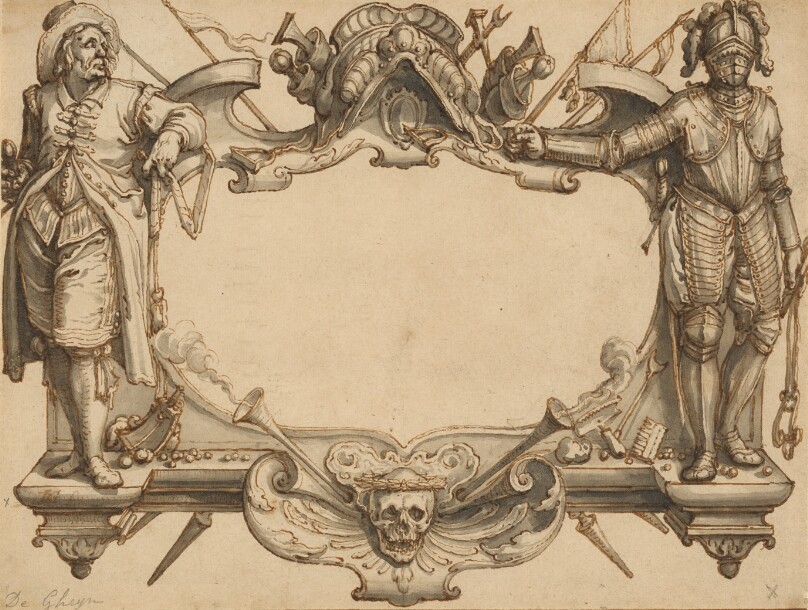
Design for the Title Page of "The Exercise of Cavalry"
Creator
Jacques de Gheyn IIDutch Artist · 1565–1629
All works by this person →Initially trained by his father, Jacques de Gheyn II moved to Haarlem around 1585 to study with Hendrick Goltzius for five years. He absorbed Goltzius's sinuous linear technique, which appeared in de Gheyn's early engravings. He moved to Leiden in the mid-1590s, then gave up engraving around 1600 and began painting and experimenting with etching. By 1605 de Gheyn had settled in The Hague, where he
More on Getty ULAN- Date
- 1598–1599
- Medium
- Pen and brown ink, brush with gray wash; incised for transfer
- Culture
- Dutch
- Department
- Drawings
- Institution
- Getty Museum
- Object ID
- 82d7ca21-eab9-49c6-83f3-a4ac7a93b4d4
From the Getty Museum record
An armored and an unarmored cavalryman lean against the frame of an empty cartouche that pliantly melts into grotesque strapwork. A witty arrangement of equestrian accouterments decorates the top and bottom, including a saddle laden with weapons, flags, stirrups, a curry comb, and other brushes. A laurel-crowned skull and smoking trumpets below symbolize death and fame. The guns and blades that extend up and down from the cartouche evoke the battle charge and give a three-dimensional depth to the scene. Jacques de Gheyn drew this elaborate frame as a model in reverse for the title page of *The Exercise of Arms*, published in 1607. Conceived as a military handbook for the cavalry regiments of the Dutch army, *The Exercise of Arms* contained twenty-two designs. Count Johann II of Nassau-Siegen commissioned the text to give the Dutch horse guards a set of clear and systematic military procedures for training soldiers.
The authoritative record is held by Getty Museum. LinkedCulture surfaces this object and its connections; it does not alter institutional metadata.
Get printable QR codesHide QR codes
Open QR codes for this object page and the museum record. They stay collapsed until needed.
Related across collections
Semantically similar works from Getty Museum and other institutions.