Getty Museum
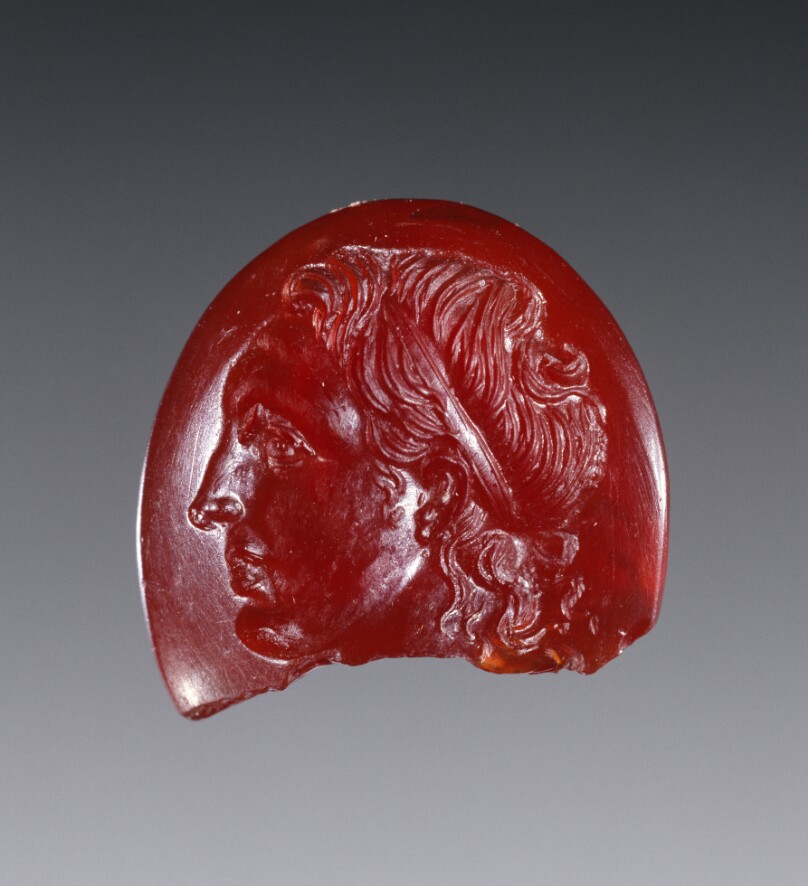
Fragment of an Engraved Gem
Creator
UnknownAll works by this person →More on Getty ULAN- Date
- first half of 1st century A.D.
- Medium
- Cornelian
- Culture
- Roman
- Department
- Jewelry
- Institution
- Getty Museum
- Object ID
- 82e78297-9d74-44c0-92a3-bdcc33f70623
From the Getty Museum record
Understanding the political importance of the royal portrait, Alexander the Great created a distinctive representation distinguished by his long, flowing, leonine hairstyle. Although he died in 323 B.C., portraits of him remained popular for centuries, especially in the early Roman Empire. The first Roman emperor, Augustus, encouraged comparisons between himself and Alexander, his most powerful predecessor. In common with the Hellenistic rulers who proceeded him, Augustus exploited this connection to symbolically emphasize his legitimacy and right to rule. Thus, Alexander portraits such as this Roman carved gem were popular during his reign. Augustus even used a signet ring with a portrait of Alexander to seal official documents. Augustus's successors likewise encouraged Alexander imagery.
The authoritative record is held by Getty Museum. LinkedCulture surfaces this object and its connections; it does not alter institutional metadata.
Get printable QR codesHide QR codes
Open QR codes for this object page and the museum record. They stay collapsed until needed.
Related across collections
Semantically similar works from Getty Museum and other institutions.