Getty Museum
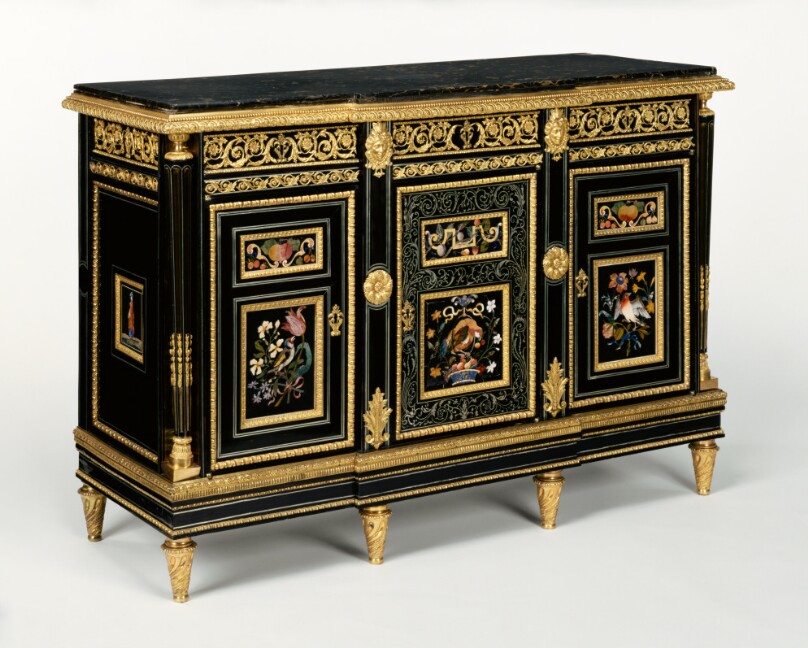
Cabinet (one of a pair)
Creator
Adam WeisweilerFrench Artist · 1744–1820
All works by this person →Like many other important *ébénistes* of the 1700s, Adam Weisweiler was German-born. Although scholars know nothing about his apprenticeship and early training, church records show that he was established in Paris in 1777, the year he was married. He became a *maître-ébéniste* (master cabinetmaker) in 1778, set up his workshop in the unfashionable quarter of Paris on the rue du Faubourg Saint-Anto
More on Getty ULAN- Date
- about 1785; pietra dura plaques mid-17th–mid-18th century
- Medium
- Oak, pine, and beech veneered with ebony and mahogany; pewter stringing; set with pietra dure plaques; gilt-bronze mounts; portor d'Italie marble top
- Culture
- French (cabinet); Italian (pietra dure)
- Department
- Decorative Arts
- Institution
- Getty Museum
- Object ID
- 84dfa347-2f7b-4df1-b4ee-efa21e68ad4a
From the Getty Museum record
From the Renaissance, art connoisseurs valued naturally colorful and rare hardstones, known as *pietre dure*, especially when they were arranged by artisans into plaques of mosaic patterns or pictorial reliefs. Often, the more splendid plaques were mounted into custom made and suitably grand cabinets. The *pietre dure* plaques on this cabinet date from the mid-1600s to the mid-1700s; they were probably made by Italian craftsmen working in Rome, Florence, or Paris at the Gobelins manufactory. This particular cabinet passed through the Revolutionary-era Parisian art market in 1790 and 1793 before being acquired by the English ambassador to Saint-Petersburg, Russia, in 1808.
The authoritative record is held by Getty Museum. LinkedCulture surfaces this object and its connections; it does not alter institutional metadata.
Get printable QR codesHide QR codes
Open QR codes for this object page and the museum record. They stay collapsed until needed.
Related across collections
Semantically similar works from Getty Museum and other institutions.