Getty Museum
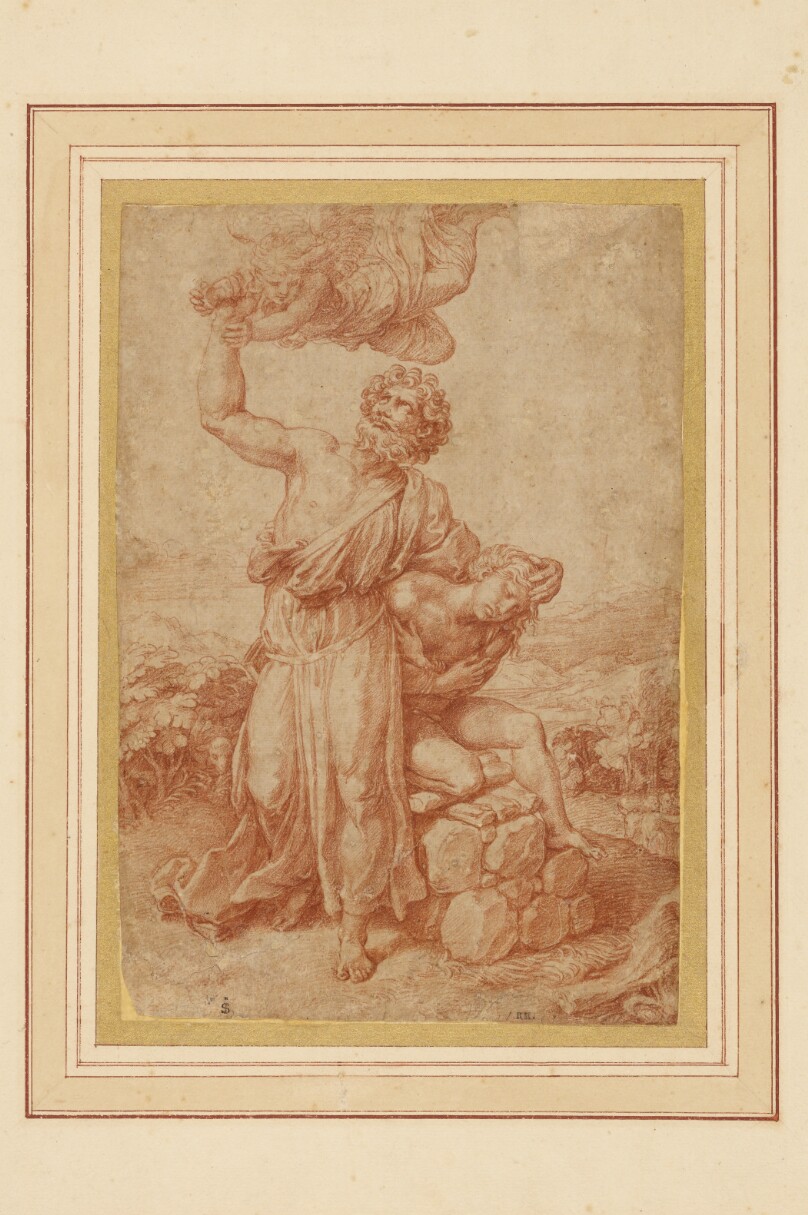
The Sacrifice of Isaac
Creator
Giulio Romano (Giulio Pippi)Italian Artist · 1499–1546
All works by this person →Giulio Romano was so famous in the century after his death that he is the only "modern" artist mentioned by Shakespeare in a play. A Roman native, by about 1515 he was working for Raphael in the Vatican, eventually becoming the master's most trusted aide. Raphael's late works indicate the increasing torsion and tension that Mannerist artists like Giulio would bring to full flower, ideas that Giuli
More on Getty ULAN- Date
- about 1516–1518
- Medium
- Red chalk
- Culture
- Italian
- Department
- Drawings
- Institution
- Getty Museum
- Object ID
- 853a8ebb-2287-4f76-8b40-c2a082de26a8
From the Getty Museum record
To test Abraham's faith, God ordered him to sacrifice his only child Isaac. Abraham bound Isaac, laid him on the altar, and drew his knife to kill him. At that moment, an angel appeared and held back Abraham's hand, saying, "Now I know you are a God-fearing man, as you have not withheld your only son from me." Giulio Romano captured the scene's drama through the energetic swoop of the angel that hovers over Abraham's head. Abraham peers up astonished, while Isaac cowers on the stone altar. The figures all have squat, stocky proportions, broad faces, and hair and beards composed of solid, horn-like locks and curls. Some scholars speculate that Raphael, Giulio's master, may have begun the drawing, allowing his student to finish it. The drawing was probably made in preparation for a print. The artist used a stylus to outline the scene at first, then fleshed out the composition more fully in red chalk. An existing engraving corresponds in size and detail to this work.
The authoritative record is held by Getty Museum. LinkedCulture surfaces this object and its connections; it does not alter institutional metadata.
Get printable QR codesHide QR codes
Open QR codes for this object page and the museum record. They stay collapsed until needed.
Related across collections
Semantically similar works from Getty Museum and other institutions.