Getty Museum
Attic Red-Figured Kylix
Creator
Brygos PainterPainter
All works by this person →Working in Athens in the early 400s B.C., the Brygos Painter was a prolific decorator of red-figure cups. Over two hundred vases have been attributed to him, including a limited number of shapes other than cups and some vessels in the white-ground technique. Having learned his craft from Onesimos, the Brygos Painter was himself quite influential and was the center of a large circle of painters. Th
More on Getty ULAN- Date
- 490–480 B.C.
- Medium
- Terracotta
- Culture
- Greek (Attic)
- Department
- Vessels
- Institution
- Getty Museum
- Object ID
- 85e1081f-4094-4e4b-96cf-70d83295d96f
From the Getty Museum record
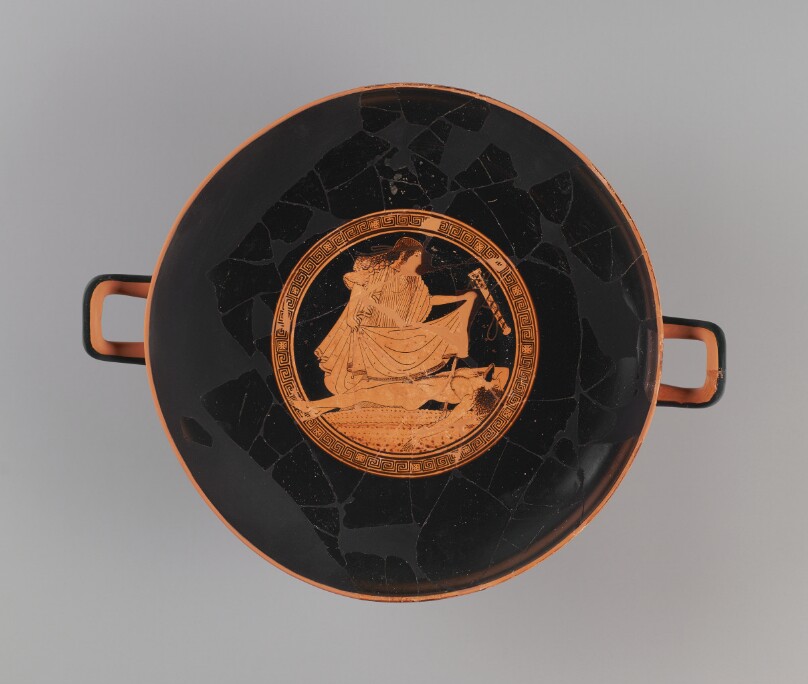
*He must not be seen! I will cover his body, I will wrap him completely in my mantle. No one who loved him could bear to see the dark blood pouring from his nostrils and the raw wound in his breast.* So declared Tekmessa when she discovered Ajax’s dead body in an Athenian tragedy by Sophokles. Ajax was one of the greatest of the Greek heroes in the Trojan War. The matter of his suicide was recounted in epic poetry now lost to us, but Greek vase-painters drew on this tradition in showing his death. The interior of this Athenian red-figure cup shows Ajax impaled on his sword. Tekmessa, daughter of the king of Phrygia, and Ajax’s prize in war, rushes to cover the corpse with a cloak. The body lies supine, the blade emerging from Ajax’s chest. His head is cast back, the beard projecting upwards, and long hair trails behind his head. Beneath the body, the Brygos Painter attempted to convey the texture of the pebble beach where the hero set up his sword. The exterior of the cup presents the events leading to Ajax's suicide. After Achilles had been killed, Ajax recovered his body from the Trojans. He expected to be rewarded with Achilles' armor, but Odysseus, who had fought off the Trojans as Ajax carried off the corpse, also laid claim to the armor. One side of this cup shows the two heroes with swords drawn, quarreling over who deserves the prize. Their comrades have to restrain them as Agamemnon tries to keep them apart. On the other side, the Greeks cast votes in the form of small stones piled on a low platform in front of the opponents. At the right side of the scene, the despondent Ajax clutches his bowed head, having lost by one vote.
The authoritative record is held by Getty Museum. LinkedCulture surfaces this object and its connections; it does not alter institutional metadata.
Get printable QR codesHide QR codes
Open QR codes for this object page and the museum record. They stay collapsed until needed.
Related across collections
Semantically similar works from Getty Museum and other institutions.