Getty Museum
Subgeometric Plate
- Date
- 680–670 B.C.
- Medium
- Terracotta
- Culture
- Etruscan (Caeretan)
- Department
- Vessels
- Institution
- Getty Museum
- Object ID
- 866b5add-5dcc-4e8e-bf24-55d71e54fb2a
From the Getty Museum record
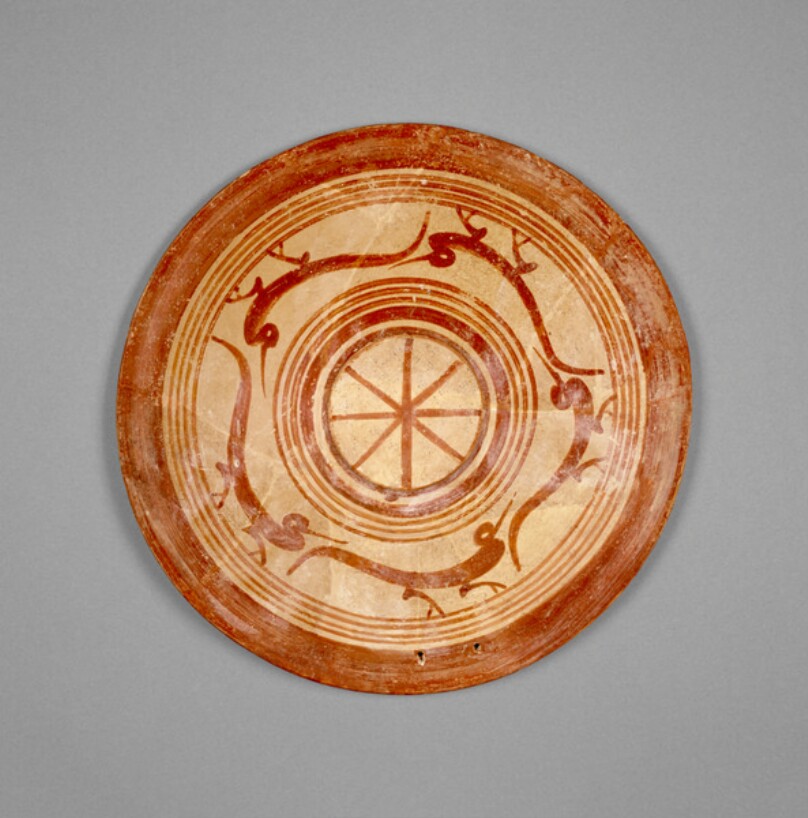
On the exterior of this plate is a frieze of five elongated herons moving to the right, all in silhouette but for their reserved eyes. Two perforations at rim, probably for suspension, appear to have been punched from the (concave) interior side, where they are of uniform diameter. There is a single reserved band on inside. This and a second plate (see [96.AE.138.1](http://www.getty.edu/art/collection/objects/29686/)) may be considered a pair given their almost identical decoration and size. They belong to a large group of plates named the "Heron Class" (Gruppo ad aironi) after their most common subject. The Etruscan term for this type of plate, "spanti," is inscribed on a few typical examples from Caere and environs. The plates' function remains uncertain, but the presence of suspension holes on some examples indicates that they were hung on a wall or stand. It is likely that this Etruscan form ultimately derives from an eighth-century-B.C. Phoenician prototype. Phoenician red-slip plates are especially close in shape and share? the frequent presence of similar concentric circles. The Etruscan potter created a new class of pottery by merging this Phoenician shape with a Greek decorative scheme and a traditional Etruscan bird motif. Typical of a style scholars call sub-Geometric, this plate and its mate retained the primarily linear decoration of the earlier Geometric period at a time when other artists were producing works in the new Orientalizing style. Close parallels in size, shape, decoration, and format come from the Monte Abatone, Laghetto 1, and Borgo necropoleis in Cerveteri. Pioneering artisans were active in Cerveteri and Veii, influencing figured vases and tomb painting. Most plates of this type are found in graves with larger vessels that comprise banquet sets.
The authoritative record is held by Getty Museum. LinkedCulture surfaces this object and its connections; it does not alter institutional metadata.
Get printable QR codesHide QR codes
Open QR codes for this object page and the museum record. They stay collapsed until needed.
Related across collections
Semantically similar works from Getty Museum and other institutions.