Getty Museum
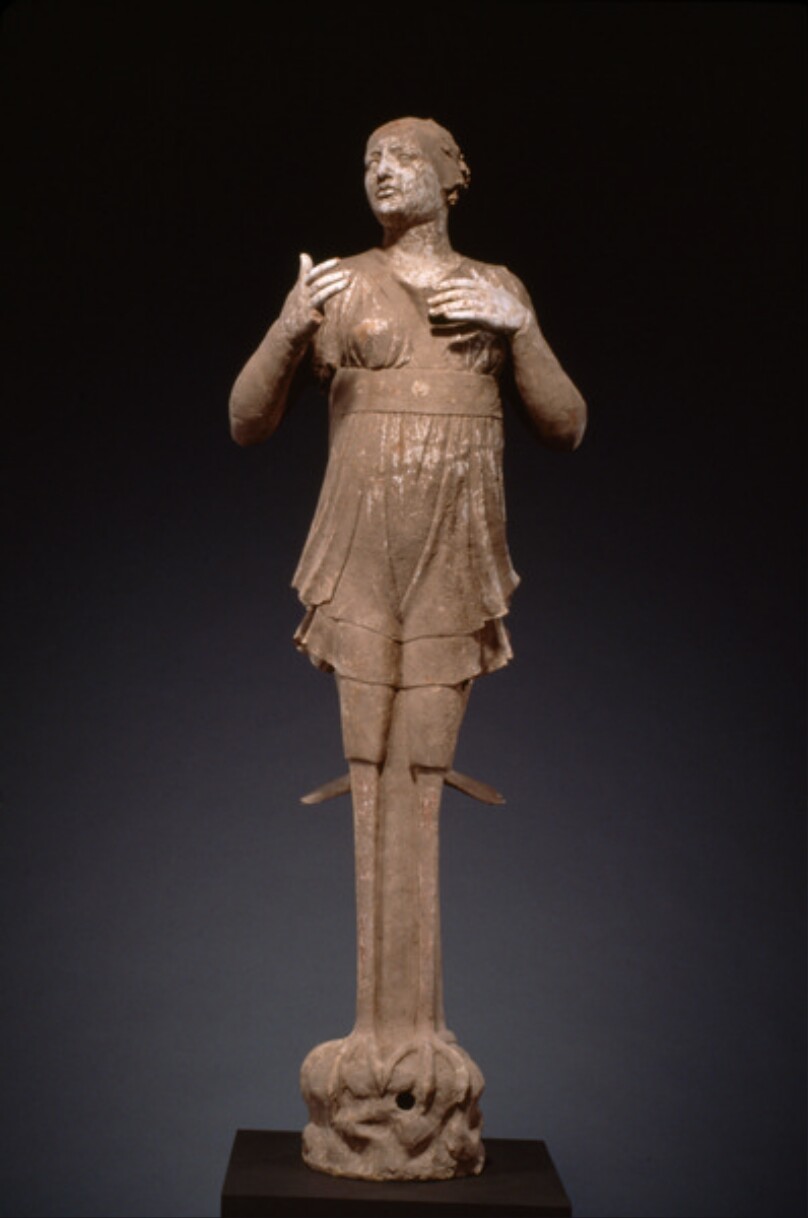
Statue of a Standing Siren
Creator
UnknownAll works by this person →More on Getty ULAN- Date
- 330–300 B.C.
- Medium
- Terracotta with white slip and polychromy (red)
- Culture
- Greek (South Italian, Tarantine)
- Department
- Sculpture
- Institution
- Getty Museum
- Object ID
- 8700e8a0-405e-4065-bfdc-2d5098608ccc
From the Getty Museum record
The upper half of the Siren’s body is human, while the lower half features a bird’s tail, legs, and talons, which grip a small, rocky base. The bird part is identical to a second Siren (76.AD.11.2), both of which compose a group with a seated poet, possibly Orpheus (76.AD.11.1). The Siren wears a thigh-length chiton with an apoptygma (cape-like fold) that clings to her body, forming “windswept” pleats. A sash is wrapped high around the chest and two shoulder straps cross over the bust, in the opposite direction relative to those of the other Siren. Her left hand is held in front of her chest, and her right arm stretches further out, a pose that suggests singing or dancing. Her face, turned proper right, has features resembling those of the seated poet: well-defined, almond-shaped eyes with a low eyebrow ridge; straight nose with a rounded tip; clearly defined, fleshy lips and prominent chin. Her short neck is marked by a “Venus ring.” Roughly modeled, short curls, most of which have broken off, are applied to her head. There are three holes on the rocky base and beneath her tail. Sirens were mythological creatures whose singing lured sailors to their deaths. While the precise identity of the seated poet is uncertain, the imagery of the sculptural group is funerary in nature and may have decorated a tomb.
The authoritative record is held by Getty Museum. LinkedCulture surfaces this object and its connections; it does not alter institutional metadata.
Get printable QR codesHide QR codes
Open QR codes for this object page and the museum record. They stay collapsed until needed.
Related across collections
Semantically similar works from Getty Museum and other institutions.