Getty Museum
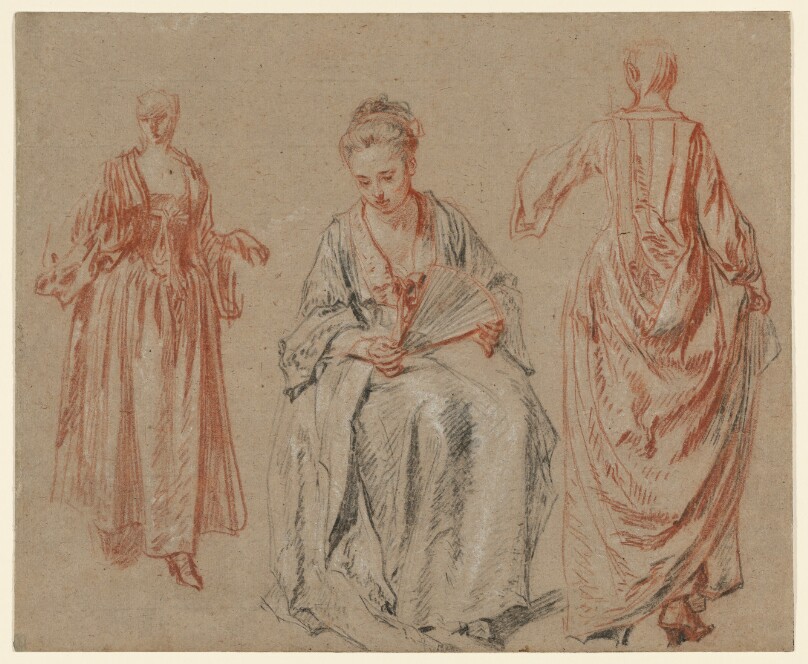
Studies of Three Women
Creator
Jean-Antoine WatteauFrench Artist · 1684–1721
All works by this person →The son of a roof tiler, Jean-Antoine Watteau showed a penchant for drawing and painting early in life. At eighteen he was apprenticed to a painter in his native town of Valenciennes. Soon after, with little money and few possessions, he made his way to Paris, where he made a living by copying the works of Titian and Paolo Veronese. There he entered the studio of Claude Audran III, the most renown
More on Getty ULAN- Date
- about 1715–1716
- Medium
- Red, black, and white chalk
- Culture
- French
- Department
- Drawings
- Institution
- Getty Museum
- Object ID
- 88260716-f5dc-4af1-a6f1-781c1fc9bb9e
From the Getty Museum record
>It was [Jean-Antoine Watteau's] habit to make his drawings in a bound book, so that he always had a large supply of them at hand. When he was in the mood to paint a picture, he resorted to his collection of drawings and chose the figures most suited for the occasion. Just as this early biographer described, Watteau made this drawing as a study of women's costumes and movement. The central figure later appeared in his painting, *Embarkation for Cythera*, a diploma piece that gained him membership in the Académie Royale in 1717; the right figure appeared in another painting. Watteau may have first learned the three-colored chalk technique called *trois crayons* by studying Peter Paul Rubens's drawings. This example shows his mastery of the technique and of composition. Watteau achieved brilliant color effects not only through the sensitivity of his line but also by setting down each chalk separately, rather than mixing the three colors. Although each figure is a separate study, Watteau arranged the three elements to create a pleasing, balanced composition.
The authoritative record is held by Getty Museum. LinkedCulture surfaces this object and its connections; it does not alter institutional metadata.
Get printable QR codesHide QR codes
Open QR codes for this object page and the museum record. They stay collapsed until needed.
Related across collections
Semantically similar works from Getty Museum and other institutions.